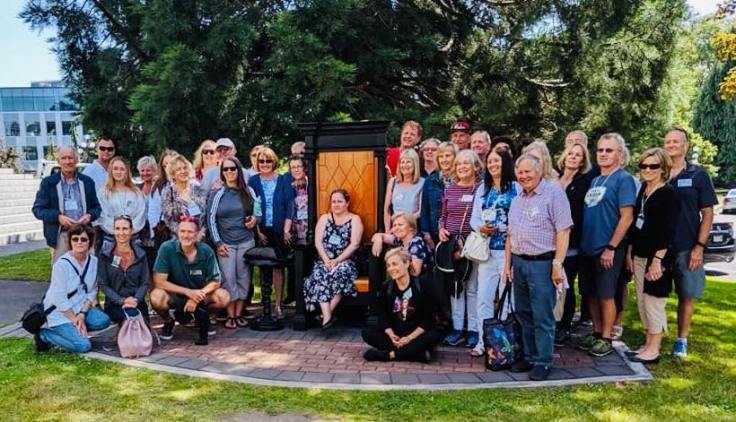
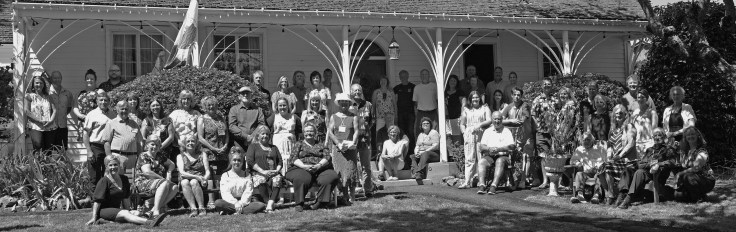
Descendants of Frederick and Mary Paulin gather here

Daily Telegraph 14 July 1916 page 11
A Handel Festival
Two hundred years ago that opulent and lavish nobleman, the Duke of Chandos, restored and reopened what was then the private chapel on his Canons estate, and what is now known as St Lawrence’s Church, Whitchurch. It was to celebrate this bicentenary that a festival was held at the church yesterday afternoon, and it was only right and proper that the music should be drawn from the works of Handel, who was the Duke’s chapel master at about that time. The festival opened with a short service, for which Mr Edward Cutler, KC, had written a pleasant and unambitious anthem, “I am Glad,” and at which a brief address on the spiritual influence of Handel was given by the rector, the Rev CW Scott-Moncrieff. Then came a selection from Handel’s music, made, for the most part, from that which he wrote at the time that he was at Canons. First came the overture to “Esther” which an improbable tradition has it that he wrote at the quaint little organ, with black naturals and white sharps, which still retains its place at the east end of the church, though it has been enlarged and improved. It is very far from unreasonable to suppose, however, that he tried the music over upon this organ as he wrote it. Next came the Chandos anthem, “O Praise the Lord with one Consent,” which, of course, with its eleven companions, was specially written for performance in this church; next, the famous hymn, “Rejoice, the Lord is King”; then the beautiful alto solo, “Like as a father,” from another of the anthems, and, lastly, the fine organ concerto in F, which, of course, is of considerably later date.
For the performance of these, Dr Churchill Sibley, who is organist of the church, had gathered together a most excellent company of singers and instrumentalists. The choir was formed of boys from the London College of Choristers and of men from the choirs at Westminster Abbey, St Paul’s, St George’s Hanover Square, and St Margaret’s, Westminster, while the band included some of the best known orchestral players in London, and the organ concerto was played by MFW Belchamber. It was not surprising therefore, that Handel’s music should have been interpreted yesterday with all the breadth, the sympathy, and the reverence that it so essentially demands. It was, indeed, a celebration of a real landmark in English musical history, that was admirable in conception and worthily carried out, and all those who were responsible for its planning and its fulfillment are warmly to be congratulated on the very large measure of success that attended their work.
Harrow Observer, 16 November 1928, page 12
Enterprise
Mr Edward Cutler, KC, whom I knew well, organist at Whitchurch in those days, and an authority on Handel’s connection with the church, probed into the matter and came definitely to the conclusion that the “Air with Variations” was composed by Handel in 1720, but it was not until 1830 – that is, 72 years after Handel’s death and 110 years after it was written – that an enterprising music publisher re-issued the music under the title of “the Harmonious Blacksmith,” the title of which bears as much relation to the composition as “Kiss me Quick and let me go” does to the fox-trot of that name.” The legend of the rain, the shelter, the smithy, and even the blacksmith, was then invented and the sale pushed by methods which put even present-day film press agents to shame. The music sold like wildfire. A copy was to be found in every young ladies’ academy; it tinkled from every harpsichord, and the interest continued and culminated until 1868 a grave appropriately found in Whitchurch and the present headstone erected by public subscription, bearing, as “Socrates” says, a sunk medallion, a hammer, anvil, laurel wreath and the opening bar of the variations. The exercises which Handel wrote – Suites or Lessons as they were called in England – were probably the most popular pieces ever written for the harpsichord, and in the early editions no mention is made of the “Harmonious Blacksmith,” but the air is simply labelled “Air et Doubles” which was the common way of describing any theme with variations. Later researches show that the air was written by a second-rate musician named Wagenseil, that Handel was quick to see its potentialities, that he had no scruple in appropriating it for his own purposes, and used it deliberately in his “suites”. Sir Hubert Parry seems to hit the nail on the head when he says that the air was republished by a certain Lintott in Bath, and he called it “The Harmonious Blacksmith” in honour of his father, who had been a blacksmith.
Harrow Observer, 29 December 1916, page 8
Mr E Cutler, KC
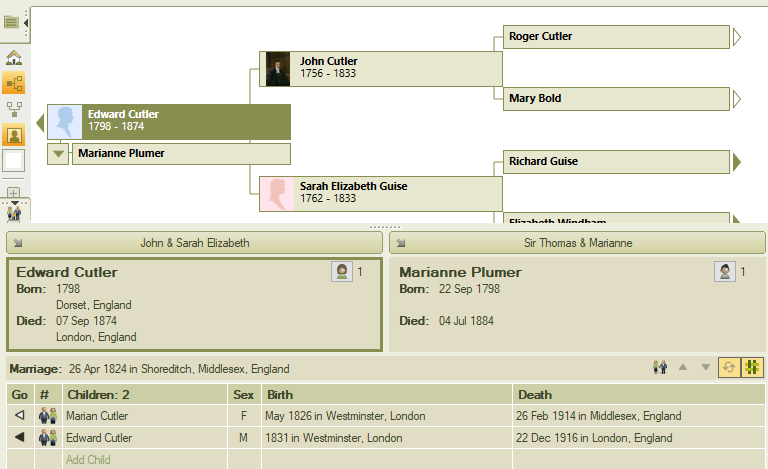
Mr Edward Cutler, KC, of Little Stanmore, died in London, on December 22, aged 85. Mr Cutler was the son of the late Mr Edward Cutler, surgeon to St George’s Hospital, and grandson of Sir Thomas Plumer, first Vice-Chancellor of England and afterwards Master of the Rolls. He was educated at Eton, Paris, Dresden, and Balliol College, Oxford, where he obtained honours in classics, and was called to the bar in 1857. In his practice he devoted himself particularly to copyright law, and this, with his knowledge of music, led to his writing a “Manual of Musical Copyright Law” (1906) and collaborating with Mr Eustace Smith and Mr FE Weatherley in a “Treatise on Musical and Dramatic Copyright.” Mr Cutler, who had taken “silk” in 1884, was on the Imperial Commission for Copyright in 1909, and was employed in the International Copyright Bill. He wrote many songs and pieces for full orchestra, organ, and pianoforte, of which, perhaps, the best known is a song called “Golden Years.” He was Grand Organist of English Freemasons in 1892-3, and at one time gave frequent recitals in public. He also wrote pamphlets in French on educational and other subjects.
Mr Cutler married Ellen Mona, daughter of Major Larkins, who was murdered at Cawnpore, and leaves one son and two daughters.

Evening Standard, 15 August 1911 page 4
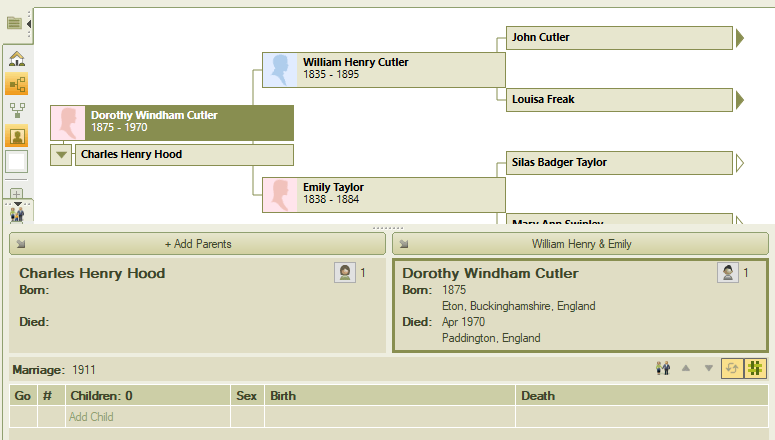
Mr Charles Henry Hood, who is to marry Miss Dorothy Windham Cutler, belongs to the Hoods of Nettleham Hall, Lincolnshire, a property now owned by his second cousin, Lieutenant Edward Thesiger Hood, RHA. His grandfather, John Hood, of Nettleham, was also Lord of the Manor of Firsty, in Lincolnshire, and inherited through his mother the Yorkshire manor of Gafforth. The Hoods themselves were settlers in Yorkshire during the seventeenth century. The first to abide in the county was the John Hood who accompanied General Monck from Scotland on his way to restore Charles II to the throne. He separated from the general at York, being left with one regiment under the command of Colonel Fairfax.
Evening Standard, 15 March 1901, page 3
The Third Members’ concert of the Strolling Players’ Amateur Orchestra (ladies night) was given at the Queen’s Hall, and was favoured with a full attendance. In the unavoidable absence of Mr Norfolk Megone, Mr William Shakespeare took command of this first-rate force of amateur musicians. A varied programme was offered, including both light and serious music, ranging from Nicolai’s overture, “Merry Wives of Windsor,” to Schubert’s unfinished B minor symphony. The orchestral work was more successful in the less academical works. The rendering of the symphony was good, better, perhaps, in the second movement than in the first, but this work contrasts received somewhat mechanical an interpretation. In other words, its treatment may be described as unconvincing and wanting in feeling. The orchestra was far more successful in Mr Landon Ronald’s “Suite de Ballet” which, conducted by the composer, was received with much appreciation. Vocal relief was supplied by Miss May Hayden and Mr Whitworth Mitton. Miss Hayden is gifted with a contralto voice quite suited to the songs chosen as her contributions, but some more experience will no doubt enable her to improve her production. Mr Whitworth Mitton confirmed the good impression already formed of the quality of his voice. If it were not for the laziness of enunciation, which he will no doubt conquer in due time, it might be justly said that this young singer is one of the most grateful now before the public, and with attention given to this one fault, a very bright future lies in his grasp. Mr Julian Clifford gave a very intelligent reading of Liszt’s Concerto for piano and orchestra, the well-known No 1 in E flat. Mr Harold Garstin was an efficient accompanist, and Mr Edward Cutler, the eminent KC, favoured the audience with an organ recital between the parts, including two musicianly works from his own pen.
Evening Herald, 5 May 1903 page 1
Barrister and Musician
Mr Edward Cutler, KC, the well-known barrister, celebrated his seventy-second birthday on Monday. His mother was the daughter of Sir Thomas Plumer, master of the rolls. Mr Cutler, who became a barrister in 1857, is the most accomplished pianist in his profession. He has composed many songs and pieces for the organ and pianoforte, and for several years was Grand Organist of the English Freemasons. He is also a fine French Scholar, having once resided in Paris. Mr Cutler is part author of a law treatise on musical and dramatic copyright.
Daily Mirror, 11 October 1913 page 13
Another Pearl robbery
Details became known yesterday of a daring theft of jewels worth L1000, including a necklace of eighty-two pearls and diamond earrings, from the residence of Mr Edward Cutler, KC, of Eaton-Place, Belgrave-square.
On going to her bedroom, Mrs Cutler found that draws had been opened with a key and the jewels abstracted. It was then discovered that a French manservant had disappeared.
Daily Record, 11 October 1913 page 6
Pearl Necklace Stolen
Another chase for the London police
The London police are investigating a daring theft of jewels from the residence of Mr Edward Cutler, KC, of Eaton Place, Belgrave Square.
The stolen articles include of a pearl necklace, consisting of 82 pearls; a gold curb bracelet, diamond earrings, and a gold chain bag – the whole being valued at L1000. They are the property of Mrs Cutler.
Most of the jewels had been extracted from a jewel case.
The robbery was discovered by Mrs Cutler herself when she went to her bedroom, at the back of the house on the second floor, and found it in great disorder. The drawers which had contained the jewellery had been opened with a key, and one of the pearls of the necklace was found lying on the floor.

Cheltenham Chronicle and Gloucestershire Graphic, 29 August 1865 page 8
Arrivals, Departures, and removals
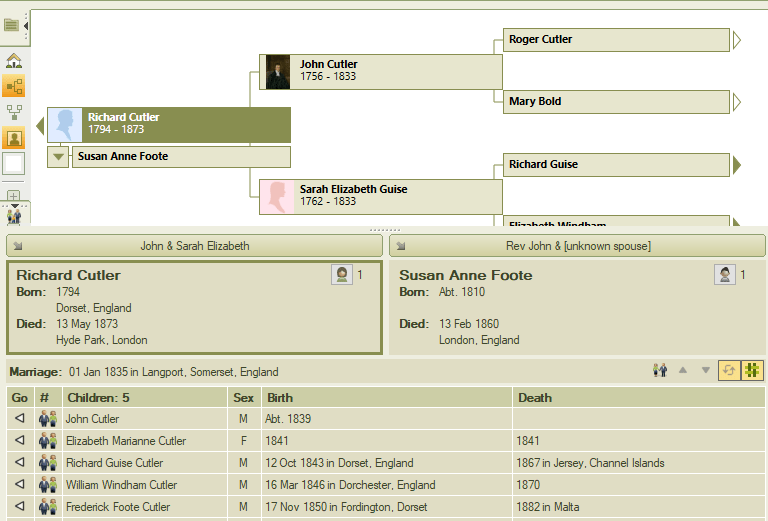
Rev R Cutler, Mr Guise Cutler, Mr W Windham Cutler, and Mr FF Cutler, 1 Spa place.

Cheltenham Chronicle and Gloucestershire Graphic, 8 July 1847 page 2
The annual election of three fellows into the council of the Royal College of Surgeons took place on Thursday, when Mr Edward Cutler, surgeon to the St George’s and Lock Hospital; Mr Charles Aston Key, Senior surgeon to Guy’s Hospital; and Mr Caesar Henry Hawkins, surgeon to St George’s Hospital, were duly re-elected. After the election the Fellows adjourned to their dinner at the Freemason’s tavern. It deserves to be mentioned that the leading medical practitioners of Birmingham, Bath, Exeter, Salisbury, Bristol, Norwich, Gloucester, & c, attended on this occasion to vote for the above gentlemen.
Montreal Gazette, 27 February 1924 page 1
WE Cutler delayed
Will join East African Expedition later
By John MacCormac, special cable from the Gazette’s resident staff correspondent
London, February 26 – The British Museum expedition to German East Africa, which was to have sailed from London under the leadership of WE Cutler, of Manitoba University, has sailed without him. The dock strike was the cause and Cutler will instead sail from Marseilles on Thursday. The expedition will explore the fossil remains which were found by Germans in East Africa before the war and which include the largest dinosaur specimens yet unearthed. Cutler has had the unrivaled experience of collecting for the British Museum and other museums large dinosaurian and similar fossils in North America.
 The Amazing Paulin(e) Family