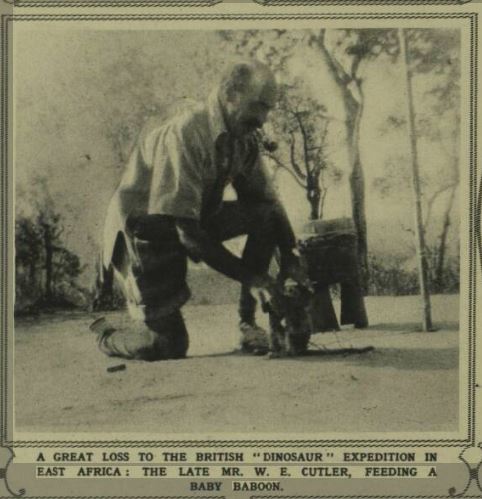
Personalities of the Week: People in the Public Eye
Mr. WE Cutler was in charge of the British Museum East African Expedition in search of dinosaur remains at Tendaguru in Tanganyika Territory.
Descendants of Frederick and Mary Paulin gather here

New York Times, 13 Jan 1927
Gets Biggest Dinosaur
London Natural History Museum Assembles Tanganyika Specimen
Copyright 1927 by New York Times Company, by Wireless to the New York Times
London, Jan 12- What is expected to prove the largest dinosaur ever discovered is being assembled in the Natural History Museum here. The various remains of a mammoth specimen of this terror of the prehistoric world, found in the Tanganyika territory in Africa by the Cutler Expedition now there, were forwarded to the Museum and are being reconstructed by experts.
The plaster reproduction of the quadruped dinosaur from the Upper Jurassic stratum of Wyoming now on exhibition in the museum is 84 feet 9 inches long, and stands 12 feet 9 ½ inches high at the shoulder, but the African specimen promises to be larger.
“These finds will probably give us the largest specimen in the world, for there is every indication of a real giant.” Said a museum official.
It is expected it will prove more than 90 feet long and 20 feet high at the high legs.
Sphere, 22 Sep 1934, p 418
A Canadian Armoured Monster
“Scolosaurus Cutleri”: This fossilized dinosaur, one of the finest specimens of its kind in the world, was found in Alberta and is now in the reptile section of the Natural History Museum, South Kensington. It has never before been photographed adequately, but “The Sphere” has been able to obtain the pictures shown on this page with the help of the authorities who had the heavy glass panelling removed from the great showcase in which the monster is placed.
By Dr WE Swinton, FRSE (of the Reptile Section of the Natural History Museum, South Kensington)
The remains of this dinosaur were found, in 1914, by the late Mr. WE Cutler in the Upper Cretaceous sandstones half-way up a 400 ft high cliff bordering the Red Deer River in Dead Lodge Canyon, Alberta. Mr. Cutler was working for the Trustees of the British Museum and this sandstone slab with its bony content arrived with other material in London in 1915. On account of the War its preparation was delayed until 1919 when Mr. LE Parsons, one of the preparators, returned to his more peaceful vocation.
The removal of the matrix, or stony covering, from the bones was completed on one side and it was decided to continue the process on the other side and so have the whole skeleton free. During this second operation the preparator noticed a thin brown layer of sandstone with a more or less regular ornamentation, which proved after further investigation to be the imprint of the original skin. The skin itself has long since perished, but here, faithfully reproduced, was its cast. Plans were accordingly altered and this trace of the epidermis was slowly and very carefully followed until the whole of the back of the dinosaur was exposed. Thus, as the dinosaur now mounted on its side for better display, there can be seen the whole of the armoured back and, on the other side, as much of the skeleton as could be developed.
The armour in the skin is particularly well developed and of great interest. The neck is protected by transverse strips of bone separated by a short strip of flexible skin charged with bony granules. Together these strips are shaped rather like a skull, and unfortunately, they were so identified by the collector. Actually, the skull is missing, and probably remains on that canyon cliff separated from its exiled companion complement by “a waste of seas.”
Behind the neck plates is a considerable area of the flexible granular skin which is indented on each side where the arms meet the body. Behind this there are four transverse strips of bone, each 10 in from back to front, and all separated by narrow belts of flexible skin. Thus, the front part of the body was protected by these four belts of armour and the neck plates. The hinder half is covered by a large plate of bone apparently formed by the fusion of three transverse and inflexible strips, with traces of polygonal scutes. This buckler, or “lumbar shield” is a feature known in several other dinosaurs. The tail was apparently covered by five alternating and polygonally marked segments separated by the usual thin strips of flexible skin.
Upon this segmented cuirass were placed spines, plates and bosses of bone arranged symmetrically. There were two spikes on each side of the neck (as can be seen in the model), three longitudinal rows of somewhat flatter spikes on each side of the body, two rows on each side of the tail, and on the last segment but one of the tail, two enormous spikes. The spikes on the neck were about 6 in high, but all of them no doubt during the animal’s lifetime a horny covering which would make them even more impressive and much sharper. A whole battery of sharp spikes protected the upper arms. Between the spikes are polygonal plates of bone, and elsewhere the skin is loaded with little ossicles.
Although the tail is thick and apparently unwieldy the only conceivable purpose of its tail-spikes is for offence or defence, and probably was used like a crusader’s mace.
The front legs are shorter than the hind, and the animal walked with the elbows and knees stuck out from the body and the feet wide apart. It must, therefore, have resembled a large, broad, and low tortoise with a spiky shell and a long tail: a sort of animated tank armed against its great flesh-eating contemporaries. The total length is 18 ft, the breadth 8 ft, and the estimated weight not less than 2 tons.
The late Baron Nopsca maintained that it was insectivorous, and he calculated that it probably ate 7,000 beetles and grasshoppers a week. Probably it slipped into the river and was drowned, the immense weight of its armour pulling it down and capsizing it. Lodged on some sandbank the carcase decayed, and a plane leaf actually blew on to it and was preserved. Eventually it became silted over and fossilized, to lie entombed for 75,000,000 years.
Sheilds Daily News, 24 Sep 1925
The appointment of Mr. Frederick WE Nigoed as Leader of the British Museum East African Expedition in succession to the late Mr. WE Cutler, has been made just in time to give him a chance to save the valuable specimens, already found, from being irreparably damaged by the oncoming tropical rains (says the “Morning Post”)
The situation created by Mr. Cutler’s death from fever in the Tanganyika district a few weeks ago, caused grave anxiety to the British Museum officials, for the maze of material which he had succeeded in excavating and bringing together was know to be still unpacked. The rainy season is approaching, and if the fossil dinosaur remains, which comprise a large part of the collection, had been exposed to the rains very serious damage would have inevitably resulted.
It is devoutly hoped that Mr. Migeod will sail for Africa on the 8th of next month, will be able to pack and despatch to England the entire collection just before the wet period sets in.
Mr. Migeod has lived many years in Africa, and possesses an extensive knowledge of the inhabitants.
The purpose of the expedition, it may be remembered, is to excavate the fossil remains of prehistoric animals in the strata of the Tanganyika district, which are peculiarly rich in this respect. Some work was carried out years ago by the Germans, but since the war the British Museum has taken over the task of excavation.
In an interview with Sir Sidney Harmer, Director of the British Natural History Museum, a “Morning Post” representative was informed that to perform the work adequately and to bring it to a satisfactory conclusion it was necessary for the expedition to be out there for a number of years. Money, however, was the trouble.
The funds were sufficient to continue the work for a certain time, but unless subscriptions were received towards the heavy expenses of such research it would be necessary after that time to close what might be rightly described as one of the most promising fields of investigation ever discovered.
The Gazette, 5 February 1924
Canadian Scientist to Search for 8,000,000 Year Old Fossil
New York – February 4 – The steamship Cameronia departed yesterday, bearing WE Cutler of the University of Manitoba at Winnipeg, who goes to East Africa in search of fossil, known to scientists as the Gigantisaurus Africanus. The specimen is said to be at least eight million years old. The scientist will take with him into the jungle more than 100 native carriers. The heat in the section of the fossil bed ranges from 130 to 140 degrees.
Unearthed Dinosaur Skeleton
Calgary – February 4- Prof WE Cutler, who sailed Sunday from New York to East Africa on a scientific expedition, worked in the fossil beds of the Alberta badlands for the University of Alberta and for a Calgary syndicate, while a resident of Calgary. He unearthed one of the finest specimens of dinosaur skeletons ever brought to light, his discovery being housed later in the British Museum. This brought Professor Cutler international recognition.
The Winnipeg Tribune, 26 January 1924
Cutler urges Museum Here
Professor Scientist Tells of Pre-History Life on Western Plains
Intimate details of the lives of giant reptiles who were probably the most prominent citizens of the Red Deer Valley, Alberta, 4000000 years ago, were revealed by Prof WE Cutler, FGS, in a lecture at the University of Manitoba Friday night.
Prof Cutler leaves Winnipeg Monday for German East Africa, where he will lead an expedition seeking the remains of dinosaurs who lived there aeons ago.
In his discourse the speaker deplored the lack of a provincial museum for Manitoba. Rare and valuable fossils he said, were continually being discovered in the province, and the museums of the United States were getting them.
Vegetarians saurian of the period about 4000000 BC were described by the Professor, who used numerous slides in illustrations. His investigations revealed the fact that walnut, oak, fig and sassafrass once flourished abundantly in Alberta.
Winnipeg Tribune, 17 Jan 1924
Fossil Relics Reveal History
Western Canada Enjoyed Balmy Climate 12,000 Years Ago, Says Geologist
Perfect forms of fossil [illegible] relics of ages long past, when Western Canada knew a climate much warmer than the vigorous one of today were exhibited to members of the Canadian Credit Men’s Association at their weekly luncheon today.
They were part of a collection accumulated by WE Cutler, member of the staff of the University of Manitoba, and Fellow of the London Geological Society. He was the speaker at the luncheon and his talk attracted intense interest. The fossil figs were found by him in the Cypress Hills, Saskatchewan.
There is no doubt, according to Mr Cutler, that from 12000 to 20000 years ago the Cypress Hills and also Alberta, were fruit bearing territory. Not only figs grew there then, but also the accompanying plants.
During his researches in Saskatchewan and Alberta Mr Cutler unearthed large collections of dinosaur teeth and skulls of prehistoric animals, which he sent to the British museum. These relics, he said, date back to the Old Oligocene age.
The Cypress Hills are a remnant of beds that covered the whole west before they were swept away. He was not prepared to say in just what manner these beds were swept away but, in all probability, it was done by water.
“Until the later discoveries in Mongolia, Alberta it is said, was one of the richest fields in the world for searching for the remains of these ancient animals,” the speaker stated.
Mr Cutler will leave Canada shortly for England to take charge of an expedition which is being sent by the British Museum to recover dinosaurs, larger than any others unearthed in South Africa. He has not yet received definite word from England and could not give the exact date upon which he would sail.
Mr Cutler declared that Greenland once had a much warmer climate. It was never tropical, no more than the climate of Western Canada, but it was very warm. The coal beds there and also in the Red Deer district of Alberta, he said, were evidence of this. He explained that the currents of ocean govern the climate entirely. The currents pushing north made this country cold.
Edmonton Journal, 2 Sep 1925
Prof WE Cutler Dies in Africa
Manitoba Geological Expert Stricken while Hunting Huge Dinosaur Relic
Winnipeg, Sept 2 – Stricken with malaria fever, Professor WE Cutler of the University of Manitoba, who was leading a scientific exploration party in Africa in search of the bones of a huge dinosaurian reptile, died today, according to advices received here today.
Professor Cutler, assistant in the department of geology of the University of Manitoba, left Winnipeg January 30, 1924, to head the British Museum’s party of explorers to Africa.
The primary object of the project was to obtain the bones of a dinosaurian reptile of stupendous size, which was discovered by German scientists a few years before the war. When Professor Cutler arrived in Tanganyika, he found the skeleton to [illegible] of colossal dimensions, the largest ever discovered in the history of modern science.
In a report which he sent to the Museum authorities he estimated it would be twice the length of the doplodocus now in the reptile room of the historic British institution.
Professor Cutler was considered one of the best authorities on western Canadian geological history. Under the auspices of the University of Manitoba he had made extensive surveys of the formation of solid rock in both Manitoba and Saskatchewan .
He had discovered many relics of the day before the first white man set foot in the prairie country, and it had been his intention to compile a history of the natural formations of the country.
Professor Cutler was born in London, England, 42 years ago, He was unmarried.
Edmonton Journal 3 Sep 1920
Digging Fossils of Dinosaur in Steveville Field
WE Cutler Getting Another Specimen in Red River Strata
Calgary, Sept 3 – Work on a skeleton of the Ceratopsian or horned Quadruped Dinosaur, provisionally named Eo-ceratops is being proceeded with by WE Cutler, of Steveville, Alberta. One side of the skeleton is almost intact, and part of the other side, but Mr. Cutler states that the laboratories of large establishments would have no difficulty in restoring such parts by plaster casts, tinted to show restoration. The dinosaur is a finely preserved specimen, and Mr. Cutler was obliged to remove rock amounting to 100 cubic yards during the winter, the covering being over 12 feet in thickness. The skeleton is one of the Red Deer River fossils.
Calgary Herald, 10 Jun 1920
Alberta Scored for not having fossil museum
WE Cutler declares support for investigations in local field is not furnished
Does not object to export of specimens
Complains specimen of Duck-billed dinosaur lies unprotected in Calgary
Referring to the matter of the raiding of Alberta for prehistoric specimens, WE Cutler, paleontologist, of Steveville, Alberta, scores the provincial government for its alleged apathy with regard to encouraging the unearthing of these fossils and providing a suitable museum in which to keep them. He further makes several corrections in an article appearing in the Herald, May 1. He cites instances where for less than the mere asking, the government could have come into possession of very valuable and rare specimens. That it did not do so, renders whimsical in his mind, any criticism of those who have removed the natural history museums of the United States.
Alberta, he says, is not the only locality where the prehistoric remains of reptile monsters have been found. But only having been worked since 1880, the fauna was new to paleontologists. That the American scientists have taken several carloads of specimens and parts of specimens from Alberta, was true, he said: but it was also true that every species save perhaps that of ornithomimus, the bird mimic, is duplicated in the collection of the Victoria Memorial museum at Ottawa.
Specimen in Calgary
Personally, he holds no brief for the American scientists, several of whom he counts among his friendsl but when one considers, he says that the complete skeleton of a duck-billed dinosaur, which he found for the Calgary Natural History Society in 1913, under Dr E Sisley, is lying unprotected in the basement of the Calgary Courthouse, subjected to all sorts of handling by visitors, then, he declares the remarks on the deportation at the end of the Herald’s article of May 1, sounds “somewhat breezy to put the matter gently.” Quoting the sentence in that article which he refers to: “and there is no reason why that same skeleton (Cory Duck) should not be reposing in a provincial museum” he explains that the main reason why such is not possible is that there is no money available for a man to work on in order to go into the field each summer with his party and in order to have a man or two to prepare the material when brought home.
British Fossil Molluscs
During the part of his war service spent in Britain, he made a collection of British fossil molluscs. This, he says, was intended for Calgary’s museum, when a proper and scientific care and reception were assured. The work which produced them cost him something in the neighbourhood of $1000 and the collection reposes at present in the safekeeping of the British Museum of Natural History, London. He had always desired, he said, that this province should inaugurate a museum to educate its people regarding the natural wonders which it contains, and which at present, when brought to light, occasion remarks of the greatest ignorance. A classified museum in his mind, would place the whole matter on an accurate scientific basis.
Commenting on the paragraph appearing under the sub-heading “Others Ate Him” which sub-heading referred the Cory Duch, that is supposed by scientists to have formed the piece de resistance of the sea serpents of that period, he declares that the pythonomorph was not only purely marine and therefore had never seen corythosaurus but he was also previous to him in existence. Bronosaurus and diplodocus both related to each other, and with dentition too weak to eat anything harder than semi-aquatic vegetables, had both died out millions of years prior to the advent of the corythosaurus. The tyrannosaurus rex, he says, did not live here, but this error was less, owing to the fact that the almost equally as large gorosaurus lived here then. Pterandodon and pterodactyl would hardly have been able to handle him.
 The Amazing Paulin(e) Family