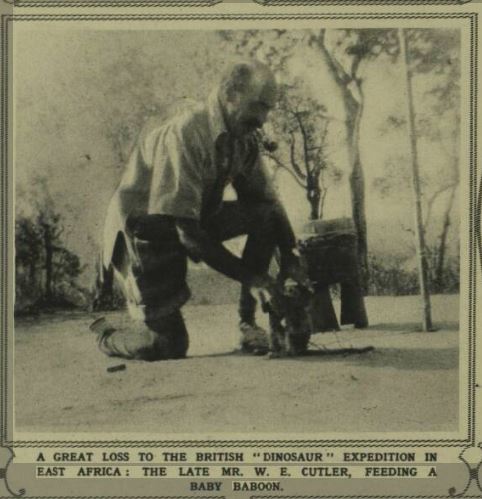
Personalities of the Week: People in the Public Eye
Mr. WE Cutler was in charge of the British Museum East African Expedition in search of dinosaur remains at Tendaguru in Tanganyika Territory.
Descendants of Frederick and Mary Paulin gather here

New York Times, 13 Jan 1927
Gets Biggest Dinosaur
London Natural History Museum Assembles Tanganyika Specimen
Copyright 1927 by New York Times Company, by Wireless to the New York Times
London, Jan 12- What is expected to prove the largest dinosaur ever discovered is being assembled in the Natural History Museum here. The various remains of a mammoth specimen of this terror of the prehistoric world, found in the Tanganyika territory in Africa by the Cutler Expedition now there, were forwarded to the Museum and are being reconstructed by experts.
The plaster reproduction of the quadruped dinosaur from the Upper Jurassic stratum of Wyoming now on exhibition in the museum is 84 feet 9 inches long, and stands 12 feet 9 ½ inches high at the shoulder, but the African specimen promises to be larger.
“These finds will probably give us the largest specimen in the world, for there is every indication of a real giant.” Said a museum official.
It is expected it will prove more than 90 feet long and 20 feet high at the high legs.
Sheilds Daily News, 24 Sep 1925
The appointment of Mr. Frederick WE Nigoed as Leader of the British Museum East African Expedition in succession to the late Mr. WE Cutler, has been made just in time to give him a chance to save the valuable specimens, already found, from being irreparably damaged by the oncoming tropical rains (says the “Morning Post”)
The situation created by Mr. Cutler’s death from fever in the Tanganyika district a few weeks ago, caused grave anxiety to the British Museum officials, for the maze of material which he had succeeded in excavating and bringing together was know to be still unpacked. The rainy season is approaching, and if the fossil dinosaur remains, which comprise a large part of the collection, had been exposed to the rains very serious damage would have inevitably resulted.
It is devoutly hoped that Mr. Migeod will sail for Africa on the 8th of next month, will be able to pack and despatch to England the entire collection just before the wet period sets in.
Mr. Migeod has lived many years in Africa, and possesses an extensive knowledge of the inhabitants.
The purpose of the expedition, it may be remembered, is to excavate the fossil remains of prehistoric animals in the strata of the Tanganyika district, which are peculiarly rich in this respect. Some work was carried out years ago by the Germans, but since the war the British Museum has taken over the task of excavation.
In an interview with Sir Sidney Harmer, Director of the British Natural History Museum, a “Morning Post” representative was informed that to perform the work adequately and to bring it to a satisfactory conclusion it was necessary for the expedition to be out there for a number of years. Money, however, was the trouble.
The funds were sufficient to continue the work for a certain time, but unless subscriptions were received towards the heavy expenses of such research it would be necessary after that time to close what might be rightly described as one of the most promising fields of investigation ever discovered.
Edmonton Journal, 2 Sep 1925
Prof WE Cutler Dies in Africa
Manitoba Geological Expert Stricken while Hunting Huge Dinosaur Relic
Winnipeg, Sept 2 – Stricken with malaria fever, Professor WE Cutler of the University of Manitoba, who was leading a scientific exploration party in Africa in search of the bones of a huge dinosaurian reptile, died today, according to advices received here today.
Professor Cutler, assistant in the department of geology of the University of Manitoba, left Winnipeg January 30, 1924, to head the British Museum’s party of explorers to Africa.
The primary object of the project was to obtain the bones of a dinosaurian reptile of stupendous size, which was discovered by German scientists a few years before the war. When Professor Cutler arrived in Tanganyika, he found the skeleton to [illegible] of colossal dimensions, the largest ever discovered in the history of modern science.
In a report which he sent to the Museum authorities he estimated it would be twice the length of the doplodocus now in the reptile room of the historic British institution.
Professor Cutler was considered one of the best authorities on western Canadian geological history. Under the auspices of the University of Manitoba he had made extensive surveys of the formation of solid rock in both Manitoba and Saskatchewan .
He had discovered many relics of the day before the first white man set foot in the prairie country, and it had been his intention to compile a history of the natural formations of the country.
Professor Cutler was born in London, England, 42 years ago, He was unmarried.
 The Amazing Paulin(e) Family