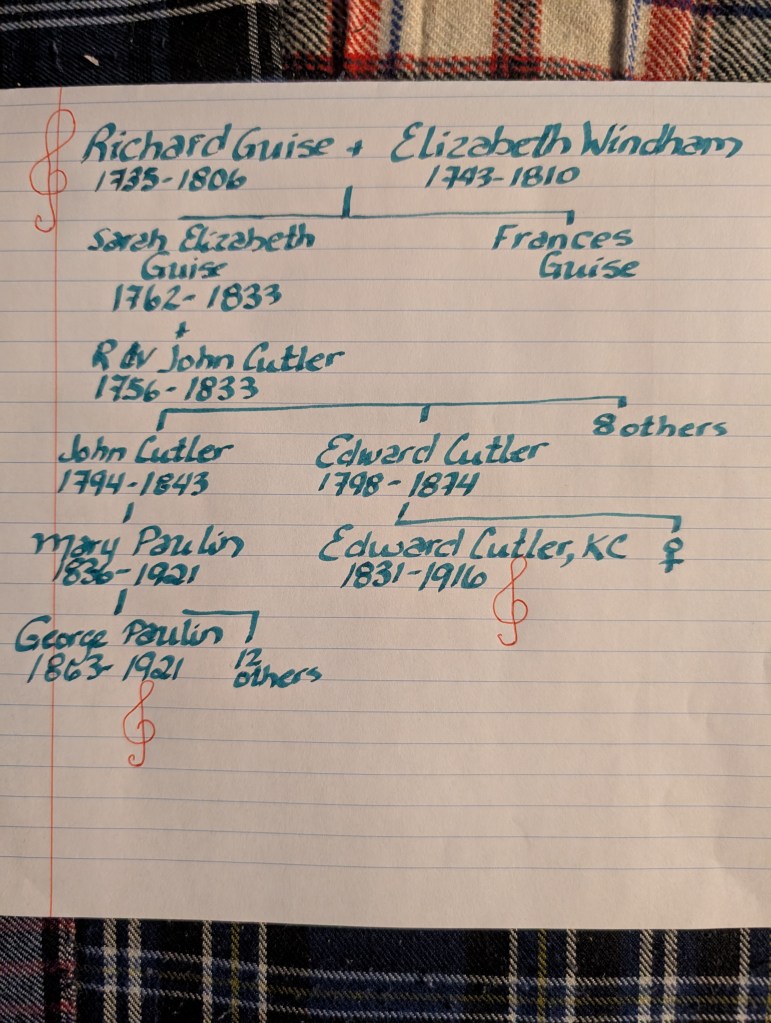
Another Organist in the tree, 2024

Richard Guise was choir master and organist at Westminster Abbey until his death in 1806. He is also buried there. He was also known as a composer, although not much survives.

Through his great-granddaughter Mary Cutler Paulin, his great 3x grandson George Paulin was also a composer and organist. He was organist at Christ Church Cathedral in Victoria BC.

Newly discovered is another organist and composer, Edward Cutler, KC, who was Richard’s great-grandson. While professionally Edward was a lawyer he was known as an organist and a composer.

I have actually found a recording of one of his compositions on You Tube – here

Here is his obituary:

Harrow Observer, 29 December 1916, page 8

Mr E Cutler, KC

Mr Edward Cutler, KC, of Little Stanmore, died in London, on December 22, aged 85. Mr Cutler was the son of the late Mr Edward Cutler, surgeon to St George’s Hospital, and grandson of Sir Thomas Plumer, first Vice-Chancellor of England and afterwards Master of the Rolls. He was educated at Eton, Paris, Dresden, and Balliol College, Oxford, where he obtained honours in classics, and was called to the bar in 1857. In his practice he devoted himself particularly to copyright law, and this, with his knowledge of music, led to his writing a “Manual of Musical Copyright Law” (1906) and collaborating with Mr Eustace Smith and Mr FE Weatherley in a “Treatise on Musical and Dramatic Copyright.” Mr Cutler, who had taken “silk” in 1884, was on the Imperial Commission for Copyright in 1909, and was employed in the International Copyright Bill. He wrote many songs and pieces for full orchestra, organ, and pianoforte, of which, perhaps, the best known is a song called “Golden Years.” He was Grand Organist of English Freemasons in 1892-3, and at one time gave frequent recitals in public. He also wrote pamphlets in French on educational and other subjects.

Mr Cutler married Ellen Mona, daughter of Major Larkins, who was murdered at Cawnpore, and leaves one son and two daughters.

Frederick Paulin to his son Frederick, 26 June 1866

Letter from Fredrick Paulin to his son Frederick Arthur Pauline, June 26, 1886

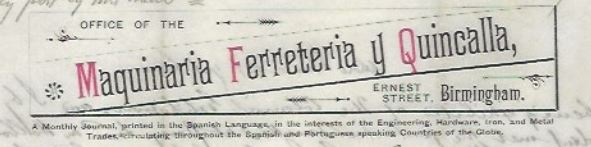
Notepaper – Office of the Maquinaria Ferreteria y Quincalla, Ernest Street, Birmingham.  A monthly journal printed in the Spanish language in the interests of the Engineering, Hardware, iron, and metal trades, circulating throughout the Spanish and Portuguese speaking countries of the Globe.

[1]

Presenting best wishes to you and your party + compts to Mr Hawkins + Mr Gibbons and Phillips weekly post by this mail

Saturday June 26, 1886

Dear Fred,

It has been warm for two days this year here yet. Yesterday and today mark how celebrated the old country is becoming, even the weather yearns to concede what the “Grand Old Moonlighter” would fair have included in his delusions.  Brummen is undoubtedly largely affected by the chopping see-saw condition of the political world and how the weather has recorded how it can be put about! And the improvement or recovery has only just been possible by the present hope and prospect that the Grand old Thimblerigger is at last detected and disgraced.

It has occurred to me that you might when you can manage it send me a letter on commerce and the progress of trade in your district for publication in the Ironmonger or Martinton Smith or British Mercantile Gazette as they may come to accept such at plated intervals of the year for a consideration, of course.  Please tell George that I called at Brimeads[?] on Wigone[?] St this week in London as to their approving him their agent in Victoria and District and Mr B said he should be very pleased and will send out the necessary lists paper terms per Turner Beetow [?] & Co, so this is good news for the piano member.  I went also to Chappell &Co who say they will send a consignment of music, but it has not been yet officially announced to me so pointedly as M Brimsmead who is celebrated for respectability and means in every way as good a house as any in the UK or Europe.

I [illegible] circular of the Victoria kettle.  The Co say they will send out ½ gross to British Columbia to you +Co.  I thought [illegible] it would be just the thing for the Paulin Bros firm to handle and they acquiesced at once.  The matters is the best I have ever seen see paper indised called “the Dominion” three men jumping on it has no discouraging effect – is not a [illegible] affair

[2]

Where I have not yet been

Is being exhibited at the Colonial Exhibition and I by accident met the patentee and maker at Perrys [illebigle] on Holbourn Viaduct.  His name is Gale but I have mislaid his circular with his address on it is some place beginning with W in PQ (Province Quebec I spose) Canada nad he told me his sone was now in Victoria to do business with this Dominion Matters. I have given him your name at Box 112 PO so you may hear from him.  Tell Ernest I will look W&B up as to the lamp question and Kynoch as to the Blue Boler + the Stanley Works as to the photo frames but I have very little time beyond that which is occupied in efforts to keep the pot boiling and it doesn’t boil over a very vigorously in fact it is slow to boil at all, and very trying sometimes.  Your dear mother is improving, seems gaining strength a bit, having apparently derived benefit from cod liver oil which is the last tried remedy.  The Henley Folks seem well.  The Regatta takes place the week after next, and will last 3 days this year because there are not to be more than 2 in a heat. The finish is to be at the point, not at the Bridge. Doesn’t this allusion show the Regatta to your mind most plainly? It will be present to my mind tho’ not literally to my vision. We are pleased to hear you are all well that the country is enjoyable climate ditto, feeling good, prospects we hope ditto, and we sincerely trust that some of the good things will be secured by the Paulin Bros firm which the CPC, the clearing off by fire of Vancouver, the Pacific being or the variety of developments in your new enterprise may place in your way or within reach.  We notice “Bold Soldier” is keeping in the race and you home with the united love of your belongings here, the sincere wish for your unity + combination in the march forward the sincere regard from of your Affectionate Father.

Benedict Bantly, conservatory, 1906

Victoria Daily Times, 11 Oct 1906

Benedict Bantly, who recently opened a studio in the Garesche building, has determined to introduce a little innovation into his methods of teaching here.  At the request of a number of friends he has decided to commence class tuition along the lines of the Liepzig and other large European conservatories. This system has served special advantages in that a pupil has the opportunity of benefiting by the instruction given to others in the same class and gains confidence by playing before them.  Other advantages are also claimed for this system.

Music Sounds Note in life of La Puentean, Benedict Bantly, 1957

Los Angeles Times, 27 January 1957

Music Sounds Note in Life of La Puentean

La Puente – Rooms filled with instruments, compositions, pictures of composers and musicians reflect the musical career of one of the city’s most colorful personalities, Benedict Bantly.

The house at 15802 E Temple Street has become so crowded with his collection that Bantly is remodelling the attic to serve as an extra music room.

Of all his possessions, the 79 year-old musician is proudest of a framed diploma from the Royal Conservatory of Music at Leipzig, Germany, where he studied from 1902 to 1906.

Started in Canada

Bantly’s musical training began more than 70 years ago when he was a boy in Victoria, British Columbia.  He and his father, brother and a sister played at dancing clubs in Victoria.

At one performance, Bantly, who was also a photographer, arrived with his violin case, only to discover that instead of the instrument he had a camera inside.

The La Puentean met his first wife while studying in Germany.  She was a vocalist and he wrote many compositions for her.

“This was a particularly mushy one,” he chuckled, thumbing through one of the many scores that fill a bookcase.

Played for Actors

During the early days of silent motion pictures, Bantly played mood music for such actors as Mary Pickford and Charlie Chaplin.

In 1922 Bantly joined the faculty of La Puente High School and was head of the music department there for 30 years.  One of his special productions was the Ben Sing Laundry act put on for the annual vaudeville.

For this number he used bamboo rakes as music stands and several authentic Chinese instruments.  He still has a Chinese violin and a botak, or mandolin, from Malaya.

Has  Dozen Violins

Of more than a dozen violins, his favorite is a model of an Amati which he played in the Leipzig Gewandhaus where Mendelssohn first conducted.

Among his smaller instruments is a 100-year-old yellow clarinet made of box wood, with only seven keys, which his father brought from Germany.  He has three others of the Albert system that date from the 80s, a mandola, similar to the present viola, and old metronomes.

Of his five pianos the oldest is a three and one-half octave piano built in Paris in 1809.  Beside a modern electric organ, which he said shocked him at first because it sounded synthetic, he has an 1875 Reed Organ.

Bantly was concertmaster for Harold Scott’s San Gabriel Valley Symphony Orchestra for 10 years.  He organized the Rotary Orchestral Club in Victoria, and returns there for a visit each year.

Practiced Diligently

Proving that there is no substitute for practice, Bantly produced a record of his practice week in his early days which showed a total of 45 hours spent on the piano, organ or violin.

Bantly, whose philosophy is “if you can’t laugh it off, it’s too bad,” believes that the best method for staying young is to keep busy.

He practices what he preaches.  He still teaches music and has organized a local Rotary music group.

Blog at WordPress.com.

Up ↑

Design a site like this with WordPress.com
Get started