Mr Stan Clives, secretary of the Sutton and District Football League, shakes hands with the league president, Mr NE Paulin, after handing over the gold cup.
Stan Clives, secretary of the Sutton and District Football League, was a proud man last week when he presented to league President Mr Norman Paulin, a gold cup.
It was the climax of months of research by Stan that had taken him through the history books of the County FA and through pages of data held in the custody of Birmingham Reference Library.
Slowly but surely the history of both the league – and of a long lost trophy – was unearthed. Now it can be told.
The Sutton League began way back in 1910 under the name of the East Birmingham League. Its name was changed by consent of council on November 21, 1918.
It was on a visit to the office of BCFA secretary Mr Bob Eden that Mr Clives saw an old forgotten trophy standing on the filing cabinet.
A closer look – and a secret was out. It was the property of the Sutton League, Mr Clive found that the cup had been handed in by a Mr HJ Dore, who was traced as having been on the league’s list of referees in the early part of this century.
Stan took the trophy home and after long pondering decided to seek to put the cup into a glamorous “gold” coat. And so, thanks to a fine piece of workmanship, the cup presented by Sir Arthur Steel-Maitland, the Sutton League’s first president, was reborn.
The trophy stands twenty inches high and is surmounted by a figure in football kit. The engraving shows the league was formed in 1910 – providing a Golden Jubilee next year.
The President, Mr Paulin, receiving the cup, thanked Mr Clives for a “wonderful surprise”. He said he was certain “endless pleasure would abound the glittering trophy.”
Over 100 members, guests and officials attended Minworth Social Club’s bowling section’s annual presentation night on Saturday.
Guest of honour was the bowling section’s president Norman Paulin, who over the years has been a keen friend and supporter of the club’s sections covering the sports of bowls, football and angling.
Mr Paulin was introduced to the company by the Chairman of the bowls section John Ford, who was accompanied by the secretary Ray Bostock.
Mr Paulin said he was happy to know that the bowling section had been able to keep going under the severe strain of having had no home green, but was glad to hear that the renovation work being carried out would ensure that all would be well for the opening of season 1977-78.
Mr Paulin said to win the championship of the Sutton Thursday League Division Three with all their home fixtures being played at either Erdington or Aston based greens was no mean feat and he congratulated the club’s skipper Wally Hassell and his colleagues in bringing the trophy back to Minworth Social.
Mr Paulin presented the trophy and personal awards to the following members: Ray Bostock, John Ford, Wally Hassell, Arthur Ford, Danny Hebden, John Jeffs, Alfred Pritchard, Tommy Thornton, Dave Haden, Charlie Sharpe, Joe Haden, Im Stubbins, Steve Turner and Sonny Hasson.
Mr Paulin also presented the Alderman Smallwood Trophy to Dave Haden, together with aggregate awards to Danny Hebden (Saturday League) and John Jeffs (Thursday League).
Secretary Ray Bostock thanked Mr Paulin for his attendance and informed him that all the members were looking forward to the forthcoming season and gave an open invitation to supporters of the sport to join them. If sufficient members are available then it would be possible to launch a second team. Mr Bostock added.
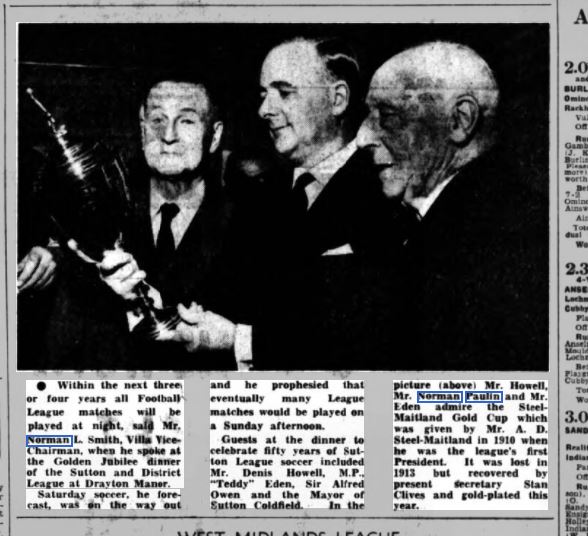
Within the next three or four years all Football League matches will be played at night, said Mr Norman L Smith, Villa Vice-Chairman, when he spoke at the Golden Jubilee dinner at the Sutton and District League at Drayton Manor.
Saturday soccer, he forecast, was on the way out and he prophesied that eventually many League matches would be played on a Sunday afternoon.
Guests at the dinner to celebrate fifty years of Sutton League soccer included Mr Denis Howell, MP, “Teddy” Eden, Sir Alfred Owen and the Mayor of Sutton Coldfield. In the picture (above) Mr Howell, Mr Norman Paulin and Mr Eden admire the Steel-Maitland Gold Cup which was given by Mr AD Steel-Maitland in 1910 when he was the league’s first President. It was lost in 1913 but recovered by present secretary Stan Clives and gold-plated this year.
An Invitation to all to attend the Electrical Fountain dedication ceremony Dominion Day 8:30pm
A fitting tribute to half a century of progress bursts into life
Mayor Fred J Hume
New Westminster
President of Hume and Rumble Ltd, electrical contractors, Mayor Fred J Hume is one of the best-known and most popular residents of New Westminster. He has given freely of his time, energy and money in his city’s behalf.
Mayor Hume has always fostered athletics in the Royal City, and is president of the Salmon-bellies Lacrosse Club.
He has been interested in the city’s affairs always, and for 11 years has held civic posts as alderman and mayor.
Three years ago he was first elected mayor, and in the past two years has not been opposed, the people preferring that he remain as their chief magistrate.
He is also the unanimous choice of the city council.
His most recent good work on New Westminster’s behalf was a real achievement. Presenting good reasons for his argument, he requested a grant of $50,000 from the CPR to the Royal City as settlement of a moral obligation incurred fifty years ago.
The money was paid at a banquet in Mayor Hume’s honour last Friday.
The firm of which he is president has been in existence 18 years, rising from a small shop in New Westminster to one that has transacted $5 millions worth of business.
Mayor Hume and Charles P Rumber, secretary-treasurer, first invested $500 each. Within a few years they had expanded and moved to Vancouver, present offices being located in the Standard Bank Building. The annual payroll fluctuates between $64.000 and $200,000.
Charles P Rumble
Sec-Treas, Hume & Rumble Ltd
Mr Charles P Rumble is secretary-treasurer of the well-known firm of Hume & Rumble Ltd electrical contractors, who handled the contract for building of Vancouver’s new electric fountain in Lost Lagoon. This construction job is unique in many ways, but is a small one compared with many that the Hume & Rumble firm has handled in British Columbia.
Here are a few of the wiring jobs done and being done by the electrical contracting company: Construction of power and telephone lines from Bridge River to Bralorne and from Bralorne to the Pacific Great Eastern; CNR Hotel; telephone line from Horseshoe Bay to Squamish; steel tower line and pole line from Lake Buntzen to Ioco.
Transmission line from Nanaimo to Duncan and from Scott Road to Crescent Beach; Second Narrows Bridge, flood lighting; Shell Oil service stations; Pacific Coast Terminals; Empress Hotel, Victoria; University buildings; Vancouver department stores; movietone equipment in 25 BC theatres.
These and numberless other huge tasks have been completed by the Hume & Rumble Company. The firm has laid considerably more than 60,000 miles of wire in British Columbia for power, light and telephone purposes.
The company is working on the new Vancouver Post Office building, new Vancouver City Hall, the TB Wing of Vancouver General Hospital, the Standard Oil plant, Burnaby; transmission lines for British Pacific Properties, West Vancouver, and miles of power lines throughout British Columbia.
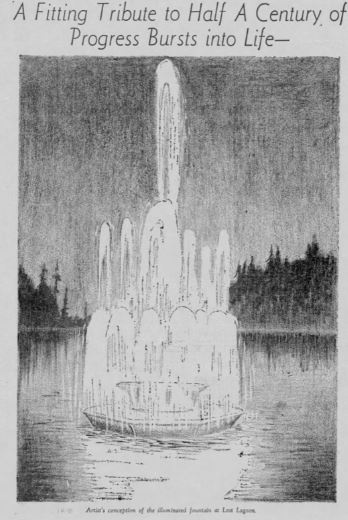
Dazzling, scintillating, jewel-like, a poem of smooth-flowing motion and ever-changing colour in setting of natural grandeur – that’s Vancouver’s newest and finest acquisition – the fountain in Lost Lagoon. All Vancouver is expected to turn out to the official opening at 8:30 pm, Dominion Day.
The fountain is worthy of all the traditions of art, worthy of Vancouver’s Golden Jubilee, and will be a permanent, decorative joy in lovely Stanley Park.
It’s a type of fountain never before constructed in Canada, and its cost, $35,000, when compared with the cost of other similar structures in the world, is a credit to the Jubilee Committee and to Hume & Rumble Ltd, electrical contractors, who are handling construction.
When operating, it is like a symphony concert, in motion and colour instead of music, says HaroldWilliams, engineer, of Hume & Rumble Ltd, under whose personal supervision the work has been done.
Lovers of beauty in Vancouver, and they number many, will be entranced by the glory of the seemingly magic display, which will be seen for the first time Wednesday night.
The fountain is not just a block of cement with a few water jets and lights attached. It’s a power and light plant in itself. The latest electrical control is employed.
At night, it is illuminated by more than 60,000 watts of electrical energy. In addition to the variety of colored floodlights concealed under water in the two bowls, which are operated in a predetermined colour cycle, the colour combination are changed by thermionic tube control.
Blending of the tints will be gradual and subtle there are 60 circuits, each controlling one floodlight.
This control is unique in Canada, this being the first time the new thermionic tube has been used to control such a variety of operations.
A synchronous motor-driven flasher regulates the water and some of the lighting effects. The motor has two drums – the first with a period of 20 seconds for the lights on the main jet and the second for a master control for the water effects with a period of 300 seconds.
Other lighting is controlled by a reactor dimming equipment, which blends and shades the various colours in numberless combinations to bring about the never-ceasing change of program.
This in turn is under control of a manual master regulator or a full automatic mobile lighting unit. The entire lot of electrical equipment is used to provide:
Motive power for the pumps
Manual and automatic control of light and water effects
Films with copper strips, each representing a certain group of lights of different colours, revolve on two drums. The amount of light and kind of light is thus controlled. These films are much similar in size to those used in an ordinary camera, but carry a metal conducting braid.
This film type regulator is used to ensure a definite, pre-determined program, which in the case of Vancouver’s fountain consists of three sets of eight films, capable of giving two and a half billion effects. The potential picked up by the braid on the film depends on the lateral position of the braid. A straight run of braid on one side of the film produces full intensity in the lighting circuit, and if the braid slopes gradually toward the opposite side, the lighting is dimmed.
Rate of change in light intensity may be made rapid or gradual.
Electrically operated valves regulate the flow of water from the jets in similar manner. The pumps are driven by two electric motors – one 25 hp capacity, the other 10 hp. The two are capable of throwing 950 gallons of water per minute, but will not operate to full capacity.
Water is pumped from the lagoon, and special filters attached to the suction nozzles keep out dirt and other impurities.
The main jet, in the centre of the smaller top bowl, will throw a stream of water 90 feet in the air, according to Mr Williams.
Indicating the scope of the effects possible with this fountain, Mr Williams points to the fact that there are 810 small jets to throw water. All of this is operated by remote control. Four switches are mounted in a special box on a light pole ashore and the current is carried out to the fountain by submarine cable. By these switches, the water jets and lights are turned on and off.
Each light is submerged and current is fed to it by waterproof wiring connections. All the water piping is in copper and brass, evidence as to the permanence of the structure.
Electrical equipment is mounted in a control room under the main lower bowl. This room is water tight, but an automatic sump pump has been installed to guard against possibility of seepage, for water would put the delicate apparatus out of running in double-quick time.
There are also special red light alarms ashore which will flash if anything goes wrong with the pump.
The fountain is situated near the centre of Lost Lagoon at the entrance to Stanley Park. It is octagonal in shape, maximum width 38 feet. The central basin or bowl is 14 feet wide, and rises three feet above the level of the lower, larger one. The whole is supported on fifty-two 45 foot by 16 inch wooden piles and the weight of water in the basins is approximately 82 tons.
Jets and streams of water are projected upwards and inwards to provide individual vertical dome-shaped sprays.
Vancouver’s Jubilee Committee and private citizens who contributed are to be commended on their work in pushing for this beautiful fountain, which is sure to be one of the major attractions during Golden Jubilee celebration.
Less than two and a half months ago the job was started by Hume & Rumble Ltd, assisted by Canadian Westinghouse Co Ltd, represented by TH Crosby, engineer.
“We’ve had to hurry,” says Mr Williams, “in that time 285 tons of cement have been utilized and all the special equipment was built.” All equipment was built in Canada and the pumps were constructed in Vancouver. All union labour was employed.
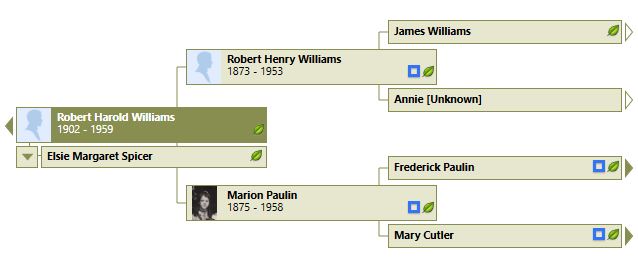
Williams – On August 11, 1953, in hospital, Robert Henry Williams of New Westminster, in his 82nd year. Survived by his wife, 2 sons and 1 daughter, RH Williams and Mrs WF Smythe, Vancouver; CF (Chuck) Williams, New Westminster; 9 grandchildren; 1 great-grandson; 1 sister, Miss Rose Williams, West Vancouver. Funeral service, Thursday August 13 at 3 pm, in the Funeral Home of S Bowell & Sons, Rev AC Hamill officiating. Internment New Fraser Cemetery.
Mr and Mrs Charles F Gardiner last evening celebrated the twenty-fifth anniversary of their wedding. They were married, as the news of twenty-five years ago, in another column, narrates, on the evening of Sept 10, 1890, in Christ Church Cathedral. The bride was Miss Amy Pauline, who still resides here. Her bridesmaids were Miss AF Gardiner, sister of the groom, and Misses Florence, Violet, Sarah, Marion and Nellie Pauline, her sisters. CP Lowe was the best man and Harold Pauline was page. The ceremony was performed by Rev Henry Kingham, a brother of Joshua Kingham and Mrs EG Miller.
“Scolosaurus Cutleri”: This fossilized dinosaur, one of the finest specimens of its kind in the world, was found in Alberta and is now in the reptile section of the Natural History Museum, South Kensington. It has never before been photographed adequately, but “The Sphere” has been able to obtain the pictures shown on this page with the help of the authorities who had the heavy glass panelling removed from the great showcase in which the monster is placed.
By Dr WE Swinton, FRSE (of the Reptile Section of the Natural History Museum, South Kensington)
The remains of this dinosaur were found, in 1914, by the late Mr. WE Cutler in the Upper Cretaceous sandstones half-way up a 400 ft high cliff bordering the Red Deer River in Dead Lodge Canyon, Alberta. Mr. Cutler was working for the Trustees of the British Museum and this sandstone slab with its bony content arrived with other material in London in 1915. On account of the War its preparation was delayed until 1919 when Mr. LE Parsons, one of the preparators, returned to his more peaceful vocation.
The removal of the matrix, or stony covering, from the bones was completed on one side and it was decided to continue the process on the other side and so have the whole skeleton free. During this second operation the preparator noticed a thin brown layer of sandstone with a more or less regular ornamentation, which proved after further investigation to be the imprint of the original skin. The skin itself has long since perished, but here, faithfully reproduced, was its cast. Plans were accordingly altered and this trace of the epidermis was slowly and very carefully followed until the whole of the back of the dinosaur was exposed. Thus, as the dinosaur now mounted on its side for better display, there can be seen the whole of the armoured back and, on the other side, as much of the skeleton as could be developed.
The armour in the skin is particularly well developed and of great interest. The neck is protected by transverse strips of bone separated by a short strip of flexible skin charged with bony granules. Together these strips are shaped rather like a skull, and unfortunately, they were so identified by the collector. Actually, the skull is missing, and probably remains on that canyon cliff separated from its exiled companion complement by “a waste of seas.”
Behind the neck plates is a considerable area of the flexible granular skin which is indented on each side where the arms meet the body. Behind this there are four transverse strips of bone, each 10 in from back to front, and all separated by narrow belts of flexible skin. Thus, the front part of the body was protected by these four belts of armour and the neck plates. The hinder half is covered by a large plate of bone apparently formed by the fusion of three transverse and inflexible strips, with traces of polygonal scutes. This buckler, or “lumbar shield” is a feature known in several other dinosaurs. The tail was apparently covered by five alternating and polygonally marked segments separated by the usual thin strips of flexible skin.
Upon this segmented cuirass were placed spines, plates and bosses of bone arranged symmetrically. There were two spikes on each side of the neck (as can be seen in the model), three longitudinal rows of somewhat flatter spikes on each side of the body, two rows on each side of the tail, and on the last segment but one of the tail, two enormous spikes. The spikes on the neck were about 6 in high, but all of them no doubt during the animal’s lifetime a horny covering which would make them even more impressive and much sharper. A whole battery of sharp spikes protected the upper arms. Between the spikes are polygonal plates of bone, and elsewhere the skin is loaded with little ossicles.
Although the tail is thick and apparently unwieldy the only conceivable purpose of its tail-spikes is for offence or defence, and probably was used like a crusader’s mace.
The front legs are shorter than the hind, and the animal walked with the elbows and knees stuck out from the body and the feet wide apart. It must, therefore, have resembled a large, broad, and low tortoise with a spiky shell and a long tail: a sort of animated tank armed against its great flesh-eating contemporaries. The total length is 18 ft, the breadth 8 ft, and the estimated weight not less than 2 tons.
The late Baron Nopsca maintained that it was insectivorous, and he calculated that it probably ate 7,000 beetles and grasshoppers a week. Probably it slipped into the river and was drowned, the immense weight of its armour pulling it down and capsizing it. Lodged on some sandbank the carcase decayed, and a plane leaf actually blew on to it and was preserved. Eventually it became silted over and fossilized, to lie entombed for 75,000,000 years.
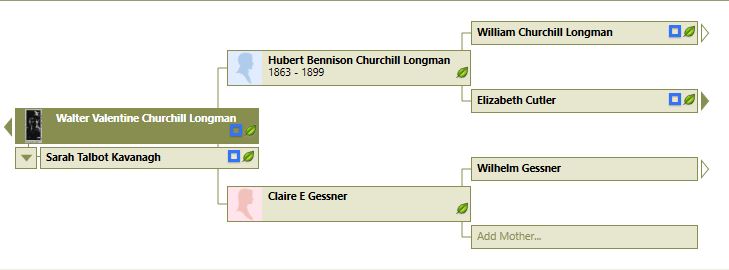
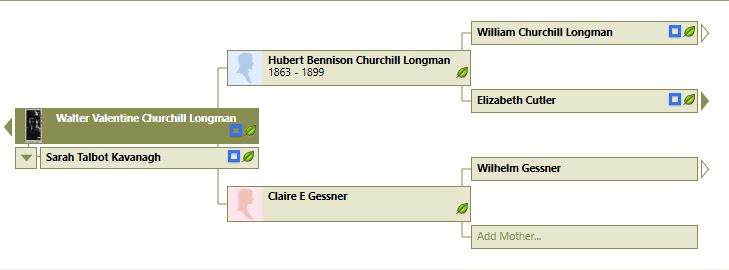
From London comes the news of the formal announcement there of the engagement of Miss Sarah Talbot Kavanagh, daughter of Mr and Mrs William K Kavanagh of St Louis, to Walter Valentine Churchill Longman, son of the late HB Churchill Longman of London, England. Mrs Kavanaugh and her daughter went abroad last spring it was while they were visiting Sir Robert and Lady Hadfield and Lady Hadfield’s sister, Miss Lily Wickersham of Pittsburg, in London, that Miss Kavanaugh and Mr Churchill Longman met. Mrs Kavanaugh and her daughter, who have been in Berlin since August, are now in London, where Mr Kavanaugh and his son J Boggs Kavanaugh have joined them for the wedding, which will take place there in April.
St Louis Post Dispatch, 23 April 1936
Announcement has come from England of the engagement of Miss Valeria Churchill Longman of Ash, Canterbury, daughter of Major WV Churchill Longman and Mrs BC Moody, and Neil Abercrombie of Sandwich Kent, son of Prof and Mrs Patrick Abercrombie. Miss Churchill Longman is the granddaughter of the late William K Kavanaugh of this city, and is related to Mrs Taylor Bryan, 4346 McPherson avenue; Miss Mary, Miss Sunie and Miss Martha Clark, 5129 Washington boulevard, and Mrs Lee Hagerman of the Lucerne Apartments. The bride to be came to America several years ago to visit relatives, and stayed with her late grandfather in St Louis.
London – Walter Valentine Churchill Longman, 45 year-old ex-Major, walked out of the London Bankruptcy Court after his first meeting of creditors and said: “I am and always will be a perfect optimist.”
When Mr Churchill Longman was 31 and serving in the Regular Army in France – he inherited L20,000 from his father.
The war ended, and he received his first cheque. Within three years every penny had been lost in high living and gambling.
L70 Hotel Bills
“It was wonderful,” he said. “My hotel bills were never less than L70 a week.
“In those days in the West End I was considered a fine fellow. I was welcome at all the gambling parties. I lost as much as L1600 in a night on the turn of the cards.”
“Night after night I played for high stakes, and got back to my rooms with the milk in time for a bath and a quick breakfast in the morning. Then on to some fashionable gathering.
“I told the court that I had live a life of idleness for the past 15 years. I have, I suppose, but all the same I have tried to obtain work.
Failed in 1925
Mr Churchill Longman had also told the Assistant Official Receiver, Mr CT Newman,” that for the past 13 years he had been living on an allowance of L300 a year from his family.
He admitted a previous failure in 1925, with liabilities of L5000 and assets of L57.
The Assistant Official Receiver made an application for an adjudication in bankruptcy. Mr Churchill Longman opposed it, and said he hoped friends or relatives would settle his liabilities in full.
As he left Mr Churchill Longman said: “One of these days I shall be recognized again as a good spender. So why worry now?”
Victoria friends will be interested in the announcement that Mr Benedict Bantly and Mrs Nellie Hickey were married in Burlingame, Calif on July 18.
Now on an extended honeymoon, Mr and Mrs Bantly will spend a brief time in Victoria Friday, arriving on the Seattle boat at noon and leaving again on the afternoon boat for Vancouver, en route to England.
Both wedding principals are well known here, Mrs Bantly being the former Miss Nellie Pauline of Victoria, and Mr Bantly being one of the city’s outstanding music teachers some years ago.





 The Amazing Paulin(e) Family