Emma Jennings Paulin to Charles Wilfrid Paulin, 1941

Perry Barr

Sunday Dec. 14th [1941]


My Dear Wilf


I was a great surprise and a very nice one to receive your parcel- No need to tell you, the contents are appreciated and will be enjoyed- also thank you for the kind thought.


I mentioned your letter sent months ago by return post, often wondered if it reached you.  Read in the paper you had the Syrens [sic] in Victoria.


Please God it will end at that.  Hilda’s hubbie expected to get his leave and be home in Jan., but do not know what will happen now, after this fresh uprising- Fred is in Africa and has been very ill with Malaria.  So could do with a rest.


[second page]

Rene’s son is on board HMS Worcestershire, destination unknown.


Hilda and Grace are still hard at it, doing my little bit, by collecting paper, cardboard, rags and bones, they are greatly needed for munitions.


Love to your wife and boy, and also to George and wife, not forgetting ~~~~~


Remember me to Uncle Fred when you see him, we are not sending any Xmas cards this year- Always thinking of you

Love Auntie Emmie


Emma Jennings Paulin to Charles Wilfrid Paulin, 1941

2/510 Birchfield Rd

Perry Barr

B’ham 30th Dec. [1941]


Dear Wilf


Many thanks for your newsy letter, before I received it, had written to thank you for the grand parcel you sent, hope you get it, but one cannot be certain of anything these days-  The snaps of you all were lovely your girlie is so much like Hilda, as she was at that age, especially the one taken with your boy, he looks a jolly little darling, your wife is very sweet.  I know good looking family, not forgetting yourself of course- a slight change from the last time I saw you.


Sent your letter to Hilda, so expect you will get a letter.  Jerry was over England last night, we had the syrens [sic] prepared to go into my table indoor shelter, but the all clear soon came.  Last winter I went down the cellar next door.  Thank goodness for my table, it takes up nearly half of my room, don’t mind that.  We brought down 3 Jerrys last night.-


[second page]

You had asked in your letter about Japan coming in, well the Wily Devils have made a good show so far, but it will be a different tale when our allies your side are ready—


You must excuse, I’m still a bit shaky- the syrens [sic] always upset me- can’t explain it.  I am not afraid, but the morning sound upsets my tummy.  Old age I guess.


Well dear, Hilda will tell you all the news- have not seen her for weeks- I like to be in my own little place and she does not get home, until past black out-


Love to your wife and family

Same to your dear self

From Aunt Emmie


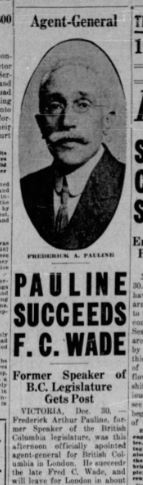
Pauline succeeds FC Wade, Victoria, 1924

Vancouver Sun, 30 December 1924

Capture


Agent General

Pauline Succeeds FC Wade

Former Speaker of BC Legislature Gets Post

Victoria, Dec 30 – Frederick Arthur Pauline, former speaker of the British Columbia legislature, was this afternoon officially appointed agent-general for British Columbia in London. He succeeds the late Fred C Wade, and will leave for London in about three weeks to assume his new and highly responsible post.

The appointment carries a salary of $8000 and is considered one of the biggest “plums” in the gift of the Government.

Mr Pauline was formerly Liberal member for Saanich, Vancouver Island, but was defeated in the general election held last June.

Sixty-three years old

Mr Pauline, who was born September 19, 1861 at Henley-on-Thames, England, is thus in his sixty-third year.  He came to Canada 41 years ago and married in March 1890, Miss Charlotte M Mesher, daughter of George Mesher of Victoria.  They have two sons.

The new agent-general graduated in public affairs as member of Victoria’s board of trade, being president in 1907-08.  In 1908 he was elected alderman for the city of Victoria. After a long and active business career in the wholesale drygoods business, Mr Pauline retired in 1911 and gave most of his time from then on to civic and political affairs.  He was first elected to the legislature in 1916 for Saanich, being re-elected in 1920, and on October 30, 1922 was chosen by his fellow legislators to be their speaker.

Steel Industry Advocate

Mr Pauline is a powerful and persistent advocate of extension of technical education and industrial development, particularly with reference to the creation of an iron and steel industry in the province.

Emma Jennings Paulin to Charles Wilfrid Paulin, 1940

2/510 Birchfield Rd

Monday 30th Dec. 1940


Dear Wilf   [Charles Wilfrid Paulin]


Received your Most Welcome letter, it had been examined, OK, yes dear we have been through the mill.  Very near to us, 3 lots of fronts and windows blown out.  Have been staying with Hilda the last two weeks.  She is out of danger area.  Got worn out staying in the cellar for 7 to 8 hours nightly.  11 hours one night, then a land mine dropped a short distance from PB Station.  So I packed up in the morning.  Have to come back for rations and to see my sister, who is in the Infirmary (89 Years of Age).  Time flies.  Would like to see you, as family man, also George, perhaps some day, you will let us have a family group, also of George and his wife.  Have sent your letter to Hilda.  She will be so pleased.  Do you remember helping me with the under garments- it was a great pity I had to sacrifice the shop, after working so hard.  Almost gave the stock away.  Never mind, I have my pension of 22/6 weekly and the best children in the world.


I am living in a 3 room cottage, up the passage in front of the old shop- we are having a lull now- so staying home.


We hear planes going over at Hilda’s and get heavy gunfire, shakes the windows, but they go to bed


[second page]

or could not carry over Hilda working over her certificate, Grace Public Assistance, Norman and his daughter are at Dunlop’s.


I thank you very much and George for the kind offer to help.  We are OK, many things rationed, but can find something to take their place, can assure you we are far from starving, as Hilda would have you believe.  Have only been to town once since the Raids- promised to meet Hilda in lunch hour- but the sights upset me, cause straight back- Poor Brum- this is no secret- published in the papers and I guess you have seen it in News pictures, my sister had- You little know how brave everybody is- bombed shops open next morning without windows and some have their goods outside.  Still carry on and will do so until Hitler is wiped off the map.  May it be soon-  Give my love to your wife and children, also George and wife, the same to Uncle Fred and family when you see them.  Lyn does predictions have all come true so far thought it might interest you- writing over to save bulk.  Wishing you all a very happy New Year.  Thank you for remembering us

Hugs and love from

Aunt Emmie


[Emma Jane Paulin nee Jennings]

Jennings in the press – 19th Century

Wolverhampton Chronicle and Stafford Advertiser, 13 September 1848 page 3

Marriages

On the 6th instant, at Gretna Green Hall, Scotland, Benjamin Willis, third son of A Jennens, Esq of Birmingham to Elizbeth, second daughter of Mr. Jennings, of Yardley.


Ari’s Birmingham Gazette, 8 April 1833 page 3

Yardley Association for the Prosecution of Felons

The members of this association, and all other persons who are desirous to attend the annual meeting at the house of Mr. Isaac Jennings, the Swan Inn, in Yardley, on Friday the twelfth day of April instant, by order of the Treasurer, Mr. John Dolphin.

Thomas Colmore, Solicitor

NB Dinner on the table at half past one o’clock, Yardley, April 6, 1833


Coventry Herald, 30 October 1846, page 4

Deaths

On Sunday last, aged 24, Mary, daughter of Mr. S Jennings, of the Swan Inn, Yardley.


Ari’s Birmingham Gazette, 14 March 1836, page 1

Genteel Apartments

A single gentleman, of serious habits, may be accommodated in a small regular family, where there are no children.  The house is detached, and situated three and a half miles from Birmingham.  A stable and gig-house if required.  Enquire of Mrs. Jennings, Swan Inn, Yardley.

Acock’s Green Star v Blackthorn- The Paulins and Football, 1881

Birmingham Daily Post, 12 December 1881, page 6


Acock’s Green Star v. Blackthorn – This match was played on the ground of the former club at Acock’s Green, on Saturday last.  The captain of the home team won the toss, and elected to play uphill with the wind.  After the kick off the ball was taken at once to the visitor’s fortress, and shots were repeatedly made at their goal, with without success.  The Blackthorn then managed to get the ball down the field, and took a shot at the Star goal, but the ball hit the crossbar, and the home team succeeded in repelling the attack.  Up to half time the game then was very equal, no goals being obtained by either side.  Upon change of ends the Star soon took the ball to their opponent’s goal, and Stevens, from a well-judged shot, scored the first goal for the Acock’s Green Star.  On recommencing the game, the home team continued to menace their opponents’ stronghold, and during a scrimmage Pauline nicely headed the ball through the Blackthorn posts for the second time.  The visitors then tried hard to equalize matters, but were unsuccessful.  No more goals being obtained by either side, victory rested with the Acock’s Green Star by two goals to none, after a very pleasant game.  Acock’s Green Star: Goal, Adams; back F Pauline; half-backs, Jenkins, Gardiner, and Parsons; forwards, Langley, Grice, EA Pauline (Captain), Neale, Bradburn, and Stevens.  Blackthorn: Goal J Phillips; backs W Phillips and Elliot; half-backs, Trout, Chapman and Blaymires; forwards, Smith, Taylor, Day, Fieldhouse and Large (Captain).

Henley Reading Chess and Music Society, 1864

Jackson’s Oxford Journal 19 Nov 1864

Henley-on-Thames

Henley Reading, Chess and Music Society  – A “penny reading” took place at St Mary’s Hall, New Street on Wednesday evening, November 9, when the following programme was most ably sustained: “the Northern Farmer” (Tennyson), Mr Lister; “The Dream of Eugene Aram” (Hood) Mr Rawlins; song “The Anchor’s Weight” (Braham) Mr W Crouch; “Smugglers and Poachers” (Grabbe) Mr John Cooper; song, “Kitty Tyrrell” (CW Glover) Mr F Paulin; “Odes on the deaths of the Prince Consort and the Duke of Wellington” (Tennyson) Mr Lister; “the Blind Highland Boy” (Wordsworth) Mr Rawlins.  The songs were accompanied by Mr A Towsey.  The chair was taken by C Lane, Esq and the hall was filled by a very attentive audience.

Royal Hotel, Sutton Coldfield, 1889

The manager of this hotel, Robert Rutherford was married to Louise Mary Paulin.  They lived here to her death in 1892.  Her death notice in the newspapers say that she actually died in the hotel.  She died during or as a result of childbirth.  Her daughter Louise Mary Pauline Rutherford survived.


Lichfield Mercury, 5 April 1889 page 5

THE ROYAL HOTEL, SUTTON COLDFIELD

From the beauty of its natural scenery, the picturesque attractiveness of its park, the bracing character of its climate, and the dryness of its soil, Sutton Coldfield has become one of the most popular resorts in the Midland Counties. During the summer season thousands of visitors flock to it, not only from the great Midland Metropolis of Birmingham and the densely populated Black Country, but from other centres of industry, and invariably derive pleasure and satisfaction from a sojourn in the locality.  To meet the growing requirements of these visitors the Royal Borough has of late years made great advances in sanitation, and in the provision of the necessary buildings for their housing and recreation.  One of the greatest desideratums of a resort such as Sutton Coldfield has become is adequate and efficient hotel accommodation, and the Royal Borough is in many ways well served in that respect. By the liberality of a company formed some years ago a palatial establishment was erected on the knoll close to and overlooking the London and North Western Railway Station, and hard by the Park Station on the Midland Railway, and is know as the Sutton Royal Hotel. The building which is of red brick, with stone dressings, is build in the Italian style of architecture and forms one of the most conspicuous institutions in the borough. Some £25,000 were spent in the building and furnishing of the hotel, and in style, finish and completeness it vies with any establishment of the kind in the Midlands. The site is a peculiarly advantageous one, and from its eminence grand views may be obtained of the park and surrounding country. As a commercial speculation the hotel was never the success which was anticipated, but it has met a want long felt in the Royal Borough, and under the new and energetic regime upon which it has now entered, better fortunes are fully expected to attend it. The management has been entrusted to a gentleman eminently qualified for the post in Mr. Rutherford, who for nearly six years acted as manager of the Birmingham Conservative Club in Temple Row, and who previously gained experience which will doubtless be valuable to him now at the Buckingham Palace Hotel, London. The new proprietors have thrown themselves with business aptitude and energy into the undertaking and the premises which had been allowed to fall into ill-repair, are at the present time undergoing thorough renovation and extension at a cost of several thousand pounds. The magnificent suite of rooms comprised within the building are being entirely re-painted, re-furnished, and newly re-upholstered, and when the work now in hand is finished, the Sutton Royal Hotel for comfort, convenience, and efficiency will compare favourably with any similar establishment in the kingdom. The building stands four stories high, and is throughout fitted with the most modern and approved appliances.  The new furniture is being supplied by Messrs. Marris and Norton, Corporation Street, Birmingham, and the painting, papering and decorating is being carried out by Messrs. John R Lea and Co, of Colmore Row, Birmingham.  The furniture is most elegant and beautiful, the decoration very chaste and attractive and the rooms throughout light, airy and cheerful, in appearance, possessing every conmitant of convenience and comfort.  The rooms are arranged on each floor on either side of a passage extending the full length of the building, and are thus rendered easy of access for all purposes, servants being within immediate call from all parts of the house.  At the present time there are about 25 bedrooms, and the additional building in contemplation proposes to make provision for five others. Lavatories are constructed on each floor, and there is an excellent bath room in the centre of the building available for all who may wish to take advantage of such a convenience. One of the chief features of the establishment is the provision of bedrooms and sitting rooms combined, which open into each other, and are let off to parties, who may be desirous of securing for themselves private apartments.  In this way ladies and gentlemen are enabled to secure the privacy of a home with such advantages as only an hotel can afford in respect of waiters, and an efficiently equipped cuisine. These considerations are evidently much appreciated, more especially by bachelors engaged during the day in business in such large centres as Birmingham, and several gentlemen are thus permanently installed in private apartments at the Royal. On the ground floor at the hotel are to be found coffee room, drawing room, assembly room, reading room, and library open to all visitors, and private sitting rooms, which may be engaged by any parties staying in the house. These rooms are elegantly furnished, magnificently upholstered, and brilliantly decorated, and for ease and comfort are not to be excelled in many of the mansions of the nobility and gentry of the neighbourhood.  On the first floor is a drawing room for ladies which is a particularly beautiful apartment furnished in Oriental style, and a fine-toned pianoforte is provided for the pleasure and recreation of visitors. The assembly room will accommodate some hundred guests, is grandly furnished, and fitted up with every requisite constituting it a most suitable place for holding banquets, meetings, masonic gatherings &c, and it is largely used for these purposes. The improvements in the course of being carried out contemplate an office in the centre of the building, the provision of a new coffee room, and the construction of a bar and smoke room, near the apartments reserved for the Manager and his wife, and in close proximity to the billiard room, which when completed will be one of the lightest and most elegant of its character in the kingdom. A bay-window is to be constructed on the side overlooking the grounds and park, and will present a grand view of the surrounding scenery.  The room is provided with two of the Boroughs and Watts tables, which have just been re-covered, the seats are artistically upholstered in Morocco, new gas fittings have been provided, and circular marble-topped refreshment tables are distributed around for the convenience of visitors. The hotel stands within its own grounds, which are being re-modelled and newly laid out, has an extensive and cleanly-kept lawn attached where visitors may indulge in lawn tennis, croquet, and other games and beyond an ample and well-stocked kitchen garden is cultivated, and adds completeness to the scene. In the basement at one end of the hotel is a very large, light and airy cooking kitchen with cool and refreshing larders attached, and the excellent servants’ hall and accommodation for domestics in the immediate vicinity; and at the opposite end are a series of capacious wine and beer cellars, where some of the choicest and most delicate wines and ales are stored, and kept in the pink of condition. The basement is connected with the upper portion of the hotel by a lift, which is readily worked, and affords facilities for rapidly despatching esculents over the house, and the establishment is thus rendered efficient and complete for the transaction of business for which it is intended.  The stable accommodation at the present time is very inadequate, but the plans of the new buildings provide for the erection of a number of horse boxes, which will doubtless be eagerly taken advantage of by visitors, more especially owners of horses at the time of the Four Oaks Parks Races.


[The Hotel closed before 1900, and became a sanitorium.  The name was taken by the Swan Hotel, which still operates as the Royal Hotel in Sutton.  The building was recently converted into condos/apartments and is called the Royal Sutton Place]

Blog at WordPress.com.

Up ↑

Design a site like this with WordPress.com
Get started