Dorchester School, 1788

Salisbury and Winchester Journal, 21 Jul 1788 page 1

Dorchester School

The Rev Mr. Cutler, with his assistant the Rev Mr. Sutton, will open his school again on the 28th of July instant. The utility of following an Eton Scolastick plan is plainly evinced by the good scholars which are forming at this school, and must be obvious to every parent that wishes to have his children well and cheaply educated.

Major Charged with Manslaughter, 1934

Dundee Courier 13 January 1934, page 5

Major Charged with Manslaughter

New Turn in Lady Doris Stapleton Case

“Only Woman I Love” Remark Recalled

Major Walter Valentine Churchill Longman (43) of Langs Road, Preston, Paignton, appeared before the Paignton magistrates yesterday in connection with the motor crash on December 20, in which Lady (Doris) Stapleton, wife of Sir Miles Stapleton, was killed.

Major Longman had been originally charged with being under the influence of intoxicating liquor while in charge of a car, but yesterday he was charged with manslaughter, and the final charges was adjourned sine die.

Mr. Lee Barber, prosecuting, pointed out that the inquest verdict should be no concern of the bench.

“Coroners’ juries sometimes do curious things,” he said.  “In this case they saw fit to say that there was no culpable negligence by Major Longman, but the police think that there was.”

Dealing with the accident, which occurred in heavy but patchy fog, Mr. Barber commented: “The prosecution say that no one except a madman or a drunkard would have proceeded at anything more than a walking pace.”

Doctor’s Evidence

Dr Harold C Adams said that after the accident Major Longman was suffering from a considerable amount of shock and was also affected by having taken alcohol.

Mr. Fisher (for Major Longman) – Did you hear him use this expression – “I have killed the only woman in the world I love.  I don’t care two hoots what happens to man, woman, or child, or to me.  I am finished.”?

Witness – Yes.

I would not describe that as being hilarious; would you? – No

Constable Toms said that at the hospital Major Longman said – “It is all my fault.  I killed her.”

The Court adjourned till Wednesday.  Major Longman was allowed bail in the same surety as for the original charge.

Prof WE Cutler dies in Africa, 1925

Edmonton Journal, 2 Sep 1925

Prof WE Cutler Dies in Africa

Manitoba Geological Expert Stricken while Hunting Huge Dinosaur Relic

Winnipeg, Sept 2 – Stricken with malaria fever, Professor WE Cutler of the University of Manitoba, who was leading a scientific exploration party in Africa in search of the bones of a huge dinosaurian reptile, died today, according to advices received here today.

Professor Cutler, assistant in the department of geology of the University of Manitoba, left Winnipeg January 30, 1924, to head the British Museum’s party of explorers to Africa.

The primary object of the project was to obtain the bones of a dinosaurian reptile of stupendous size, which was discovered by German scientists a few years before the war.  When Professor Cutler arrived in Tanganyika, he found the skeleton to [illegible] of colossal dimensions, the largest ever discovered in the history of modern science.

In a report which he sent to the Museum authorities he estimated it would be twice the length of the doplodocus now in the reptile room of the historic British institution.

Professor Cutler was considered one of the best authorities on western Canadian geological history.  Under the auspices of the University of Manitoba he had made extensive surveys of the formation of solid rock in both Manitoba and Saskatchewan .

He had discovered many relics of the day before the first white man set foot in the prairie country, and it had been his intention to compile a history of the natural formations of the country.

Professor Cutler was born in London, England, 42 years ago,  He was unmarried.

Dinosaurs in Steveville, 1920

Edmonton Journal 3 Sep 1920

Digging Fossils of Dinosaur in Steveville Field

WE Cutler Getting Another Specimen in Red River Strata

Calgary, Sept 3 – Work on a skeleton of the Ceratopsian or horned Quadruped Dinosaur, provisionally named Eo-ceratops is being proceeded with by WE Cutler, of Steveville, Alberta.  One side of the skeleton is almost intact, and part of the other side, but Mr. Cutler states that the laboratories of large establishments would have no difficulty in restoring such parts by plaster casts, tinted to show restoration. The dinosaur is a finely preserved specimen, and Mr. Cutler was obliged to remove rock amounting to 100 cubic yards during the winter, the covering being over 12 feet in thickness.  The skeleton is one of the Red Deer River fossils.

WE Cutler declares support for investigations, 1920

Calgary Herald, 10 Jun 1920

Alberta Scored for not having fossil museum

WE Cutler declares support for investigations in local field is not furnished

Does not object to export of specimens

Complains specimen of Duck-billed dinosaur lies unprotected in Calgary


Referring to the matter of the raiding of Alberta for prehistoric specimens, WE Cutler, paleontologist, of Steveville, Alberta, scores the provincial government for its alleged apathy with regard to encouraging the unearthing of these fossils and providing a suitable museum in which to keep them.  He further makes several corrections in an article appearing in the Herald, May 1. He cites instances where for less than the mere asking, the government could have come into possession of very valuable and rare specimens. That it did not do so, renders whimsical in his mind, any criticism of those who have removed the natural history museums of the United States.

Alberta, he says, is not the only locality where the prehistoric remains of reptile monsters have been found. But only having been worked since 1880, the fauna was new to paleontologists.  That the American scientists have taken several carloads of specimens and parts of specimens from Alberta, was true, he said: but it was also true that every species save perhaps that of ornithomimus, the bird mimic, is duplicated in the collection of the Victoria Memorial museum at Ottawa.

Specimen in Calgary

Personally, he holds no brief for the American scientists, several of whom he counts among his friendsl but when one considers, he says that the complete skeleton of a duck-billed dinosaur, which he found for the Calgary Natural History Society in 1913, under Dr E Sisley, is lying unprotected in the basement of the Calgary Courthouse, subjected to all sorts of handling by visitors, then, he declares the remarks on the deportation at the end of the Herald’s article of May 1, sounds “somewhat breezy to put the matter gently.” Quoting the sentence in that article which he refers to: “and there is no reason why that same skeleton (Cory Duck) should not be reposing in a provincial museum” he explains that the main reason why such is not possible is that there is no money available for a man to work on in order to go into the field each summer with his party and in order to have a man or two to prepare the material when brought home.

British Fossil Molluscs

During the part of his war service spent in Britain, he made a collection of British fossil molluscs.  This, he says, was intended for Calgary’s museum, when a proper and scientific care and reception were assured. The work which produced them cost him something in the neighbourhood of $1000 and the collection reposes at present in the safekeeping of the British Museum of Natural History, London.  He had always desired, he said, that this province should inaugurate a museum to educate its people regarding the natural wonders which it contains, and which at present, when brought to light, occasion remarks of the greatest ignorance. A classified museum in his mind, would place the whole matter on an accurate scientific basis.

Commenting on the paragraph appearing under the sub-heading “Others Ate Him” which sub-heading referred the Cory Duch, that is supposed by scientists to have formed the piece de resistance of the sea serpents of that period, he declares that the pythonomorph was not only purely marine and therefore had never seen corythosaurus but he was also previous to him in existence.  Bronosaurus and diplodocus both related to each other, and with dentition too weak to eat anything harder than semi-aquatic vegetables, had both died out millions of years prior to the advent of the corythosaurus.  The tyrannosaurus rex, he says, did not live here, but this error was less, owing to the fact that the almost equally as large gorosaurus lived here then.  Pterandodon and pterodactyl would hardly have been able to handle him.

Ex-Calgarian to Lead Scientific Party in Africa, 1924

Calgary Herald, 22 March 1924

Ex-Calgarian to Lead Scientific Party in Africa

WE Cutler is entrusted with important excavation researches

Is highly praised by London Times

Expedition is being sent out in behalf of British Museum

It has been announced that sufficient funds have now been raised to permit the British Museum to send an exhibition to East Africa for the purpose of unearthing several prehistoric fossils of dinosaurs and other animals and according to the London Times, WE Cutler, who was formerly a resident of Calgary, and who is considered one of the greatest authorities on work of this kind, has been chosen to head the expedition.  Mr. Cutler conducted successful excavations for prehistoric specimens in the Red Deer River Band Lands. He acted in behalf of a Calgary syndicate.

Speaking of Mr. Cutler’s ability, “Science,” under the date of March14, says: “Mr. Cutler has for many years had an unrivaled experience of collecting for the British Museum and other museums, large dinosaurian and similar fossils in North America, and is therefore conversant with the methods of extracting the specimens from the matrix and packing them in such a way as to withstand the stress and strain of the journey to the museum.

Germans Secure Specimens

It has been stated that during the time that East Africa was under the control of the Germans, several splendid specimens of Dinosaurian and other Paleozoic creatures were unearthed and removed to museums in Germany with some information as to the possibilities in the venture the directors of the British Museum have been considering the possibility of sending an expedition to East Africa for the past five years.

Mr. Cutler’s Assistant

LSB Leakey, of St John’s College, Cambridge, who was born in Kenya colony, and whose father is a clergyman near Nairobi, will be Mr. Cutler’s white assistant on the expedition and has been chosen to fill this office because of his knowledge of native habits, language and customs in that section of the world. Mr. Leakey is a specialist on birds, mammals and plants and will make several collections of specimens of this nature while the expedition is in East Africa.

Sites of Excavation

The sites in which the expedition will operate are about four days’ march north and slightly west of Lindi at a place called Tendaguru.  It was in this locality that the Germans unearthed the famous gigantosaurus. This site is now overgrown with a dense mass of foliage and is only sparsely inhabited but it is believed that the field may be opened up for excavation purposes without any great difficulty. Another area about two miles east in the Moemkuru Valley will also be investigated.  The working season of the year is confined to the months from May until December and during the wet season when about 17 inches of rain is precipitated both exploration and excavation are practically impossible.

Sir Horace Byatt, governor of the Tanganyika Territory has offered every assistance at his disposal to make the expedition a success and the trustees who are baking the expedition are hopeful that great results may be obtained.

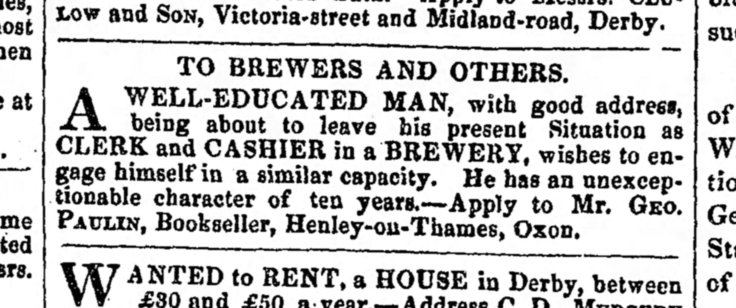
George Paulin, Auction, 1815

Jackson’s Oxford Journal, 1 Jul 1815, pg 1

Cabinet and Upholstery Stock,

Household furniture &c

Bell-Street, Henley, Oxon

To be sold by Auction

By Mr. Othwaite

(Under execution, by order of the Sheriff of Oxfordshire) on Monday, Tuesday, Wednesday and Thursday, the 3d, 4th, 5th, and 6th of July, and on Saturday the 8th of July, 1815. – All the valuable, well-selected, and extensive STOCK in TRADE, HOUSEHOLD FURNITURE, and effects, of Mr. George Paulin, Upholsterer, Paper-hanger, and Cabinet Manufacturer, Bell-Street, Henley; comprising a genteel assortment of new and second-hand 4-pst tent; and other bedsteads, with handsome cotton and scarlet Sayes furnitures, in pieces, and made up; window curtains, goose and other feather beds, mattresses, blankets, and quilts; mahogany secretary and book-cases, wardrobes, three-quarter and dressing chest of drawers, elegant loo, sofa, card, Pembroke, and dining tables, cellaret side boards, bed steps, bason [sic] stands, expensive mahogany, japaned, Grecian and other chairs, elegant chimney and other glasses in gilt and mahogany frames, a costly and ornamental cut-glass lamp chandelier, between two and three hundred yards of Brussels, Venetian, and Kidderminster carpeting, excellent assortment of hearth rugs, oil cloths, made-up bed ticks and mattress cases, handsome fringes, laces, lines, &c, between four and five hundred pieces of paper hangings and borders, large assortment of brass work, taxed cart and harness, market cart, useful grey horse, &c, &c.

The unmanufactured stock will be sold in the third day’s sale, on Wednesday the 5th of July (not in the last day’s sale, as before advertised).  It comprises seasoned mahogany in plank, boards, and veneers, wainscot boards, cherry-tree and beech quarters &c &c.

May be viewed the Friday and Saturday before and mornings of sale, which will begin each day at eleven o’clock.

Catalogues (price 6d each, to be returned to purchasers) will be delivered at the Auction Mart, London; at the principal Inns at Staines, Egham, Windsor, Oakingham, Hartford Bridge, Maidenhead, Marlow, Wycombe, Watlington, Oxford, Benson, Wallingford, Reading, and Newbury; place of sale; and of Mr. Othwaite, the auctioneer, Henley.

Sale of land, Acock’s Green, 1884

Birmingham Daily Post, 21 April 1884

Letting by Auction

Acock’s Green – to be let, on building lease, for ninety-nine years, without restrictions, a valuable plot of building land, having 62 yeard 2 feet frontage, to the Yardley Road, between Cottenbrooke, the residence of Mr J Willson, and the residence of Mr Paulin, and extending back to the canal. Area about 5A iR 15P or 25,863 square yards.  This land being near the Acock’s Green Station, where forty-six trains stop daily, is eligible for any class of property and cottages, would doubtless readily command good tenants. (Lot 6)

South Yardley – to be let on building lease, for ninety-nine years, an exceedingly eligible plot of land adjoining the residence of Mr Henry Crane, known as “Broad Yates” having a frontage of 96 yards to the road from Yardley to Stockfield and Hall Green, and continuing an area of 4503 square yards or thereabouts. (Lot 7)

South Yardley – to be let on building lease, for ninety-nine years, an exceedingly eligible plot of land, abutting on Lot 7, having a frontage of 61 yards to the road from Yardley to Acock’s Green Railway Station.  Area about 4157 square yards (lot 8)

The above will be let on terms that will enable lessees to have country gardens without being overburdened with ground rent.

Hendricks & Smith are instructed to let the above by auction at the estate sale room, 1 Newhall Street, Birmingham, at 7 pm on Thursday next, the 24th April.

Particulars and plans may be obtained from Messrs Coleman, Coleman and Springthorpe, Solicitors, 77 Colmore Row (where the draft leases may be seen after the 20th instant); or at the auctioneer’s offices, 25 Cannon Street, Birmingham

Hendricks and Smith’s next sale of properties will take place in May.

Blog at WordPress.com.

Up ↑

Design a site like this with WordPress.com
Get started