Edward Francis Meynell Cutler was born in the spring of 1847 in Kingston, Surrey, to Louisa Cutler (nee Freak). While his birth certificate lists John Cutler (Louisa’s husband) as his father, we know that this is actually not the case. He was born 4 years following his death. His baptism in 1851 in Waltham, Surrey states that his mother was unmarried.
So who was his father? His given names provide the clue. Many unwed mothers used the biological fathers’ names in their children’s given names, a way to have them recognized as the son of, or to give them some sense of paternal identity. How do we know Louisa did this for Edward? Meynell was not a name which came from her family. There were no Meynells in the tree. So was the father Francis Meynell?
There are a few Francis Meynells hanging about England at the time of Edward’s birth. Is one of them his father? Hard to determine.
I did however find this article on newspapers dot com which mentions a Francis Meynell in the Royal Navy. Compelling because Louisa’s brother in law was in the Navy, and her father had been a shipbreaker, with connections to the navy. Puts him in her network – as a possible.
I will leave it there.
The Morning Chronicle, 5 Feb 1849
Court-Martial at Naples on Lieutenant Meynell, RN – A court-martial was held at Naples, on the 23d ult, on board the Hibernia flag ship, to try Lieutenant Francis Meynell (1846), of the Bellerophon. The following members composed the court: – Captains Sir James Stirling of the Howe, 120 (President); HW Bruce, of the Queen, 116; W Ramsay, of the Terrible, steam-frigate; RL Baynes, CB, of the Bellerophon. It was in substance as follows:- That overhearing Lieutenant Meynell making observations on the multitude reports which he was obliged to receive from the master-at-arms, ship’s corporal, &c, he left his cabin, and took his place at the ward-room table, in the hope that his presence would put an end to remarks which he conceived to be highly subversive of discipline. His presence, however, at the mess-table had not the effect he anticipated; whereupon Commander Randolph desired Mr Meynell to go on deck. The latter replied he would not; he had no notion of being ordered from his own mess table as if he were one of the mess servants, but if Commander Randolph would go on deck himself, and send for him (Lieutenant Meynell) he would then obey his summons.” The court was occupied about six hours in the investigation, and finally found the prisoner guilty, and sentenced him to be dismissed her Majesty’s ship Bellerophon, and to be placed at the bottom of the list of lieutenants.
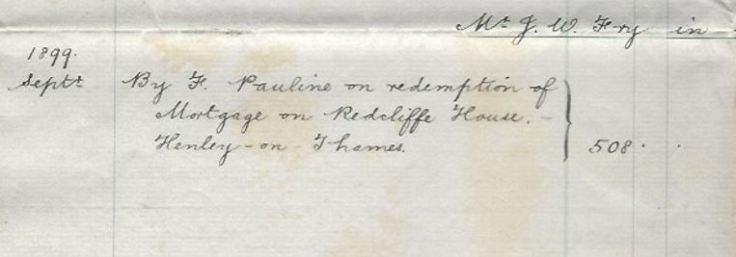
Excerpt from a document dealing with the trust originally created in 1859 when Frederick Paulin was courting Mary Cutler. This trust was created to protect the interests of Mary Cutler Paulin and her children. I am not sure why it was done, or why it took another two years for the couple to marry (after the birth of their daughter Louise and three months before the birth of their son Frederick Arthur Paulin) but it was done with her mother Louise Freak Cutler, brother William Henry Cutler, and brother in law William Churchill Longman as the original trustees. On the death of Freak Cutler and Longman, George Paulin, Frederick’s father, and George Bennett his brother in law were named as trustees. Later on J Walter Fry became a trustee.
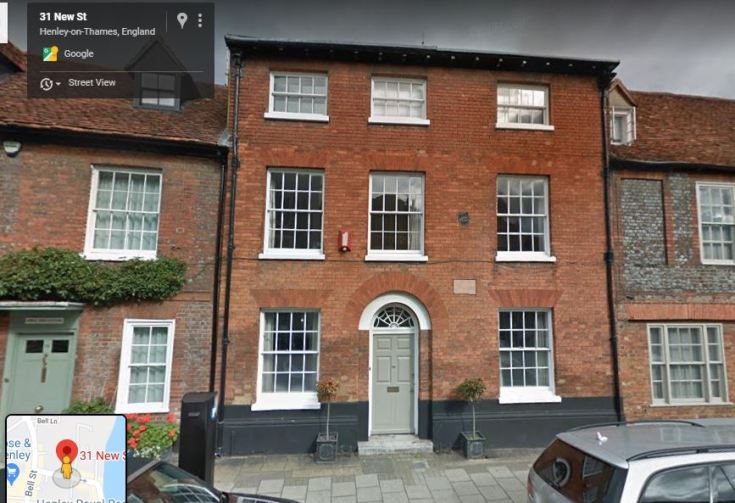
So as seen above, Redcliffe House on New Street in Henley-on-Thames was part of the trust. It is possible that this was also the house that Frederick and Mary lived when they were resident in Henley. Several censuses and city directories stated that they lived on New Street, as did Frederick’s father, George. No street numbers were provided. Their home “Henley Lodge” in Acock’s Green, Birmingham, where they lived before they emigrated to Canada was also owned by the trust.
I know that Frederick Paulin and his large family lived in Peckham, Camberwell, in 1874-5. I can pinpoint the addresses of his home and his business from several sources. For his home, we know he lived at 13 Camden-Grove, Camberwell because his daughter Sarah (aka Sadie/Sally) who was born there, his mother-in-law, Louisa Cutler, died there in April 1874. For his brewery, the Anchor, we know he owned it thanks to a great history of the Oxfordshire brewery industry by Mike Brown [Oxon Brews: The Story of Commercial Brewing in Oxfordshire, Mike Brown, Brewery History Society, 2004], who identified Frederick as owner of the brewery in his work. Also because Frederick went bankrupt, we know he owned the brewery, and have its address.
The London Gazette, 4 Sep 1874 p 4304
In the London Bankruptcy Court.
In the matter of proceedings for liquidation by arrangement or composition with creditors, instituted by Frederick Paulin of the Anchor Brewery, Saint George’s Road, Peckham, and of no 13 Camden-Grove, Camberwell in the County of Surrey, Brewer.
So the question arises where are these places? My great wish in looking these places up was of course to see if the buildings in question were still standing, and if so, what they could say about how the family lived when they were resident in Peckham.
My first search was for the house on Camden-Grove. I went first to Google Maps and tried to find Camden Grove, and that was a bust, the street name no longer exists. So then I went and googled the name Camden Grove and Peckham/Camberwell to see if there were other ways to find the street. I stumbled upon this great website which lists the changes to street names in the London area [www.maps.thehunthouse.com/streets/old_to_new_abolished_London_street_names.htm ] and found that the street had changed its name to Cronin Road in 1912. And phew, there you go.
I went onto Google street view and found Cronin Road, and was greatly disappointed to see some rather ordinary 1970-80s style low-rise apartments populating the street. The area has clearly changed a great deal for when the Paulins lived there in the 1870s.
Cronin Street from Google Maps – streetview
And now for the Brewery. I first looked up St George’s Road, Peckham on google maps to see if there was any indication that the brewery was still there. There were some older buildings on the road, but nothing clear, and to be honest the road is not small enough to say for sure, so I googled the brewery online, thinking, hoping that the place had kept its name. Nothing in the present, but I did find a website that talked about pubs in London, and there it stated that the Anchor Brewery and Tap, 165 St George’s Way was open 1878-1919, but was closed and demolished. [www.pubology.co.uk/pubs/12087.html] Now here of course, the dates don’t quite match, but it is likely not a coincidence that the Anchor Brewery and Tap on St George’s Way, Peckham was named that way, and was connected in some way the Anchor Brewery that Frederick owned, on St George’s Road. When Frederick bought it it had that name, so I would imagine they are one in the same, with just a few years gap in ownership and running. Counting Frederick’s financial downturn, the Anchor had been the subject of two bankruptcies in less than three years, so it was not a great investment.
Knowing it was demolished was a bit sad, but I checked out the neighbourhood to see if there were any indications of what it was like in the 1870s when the Paulins owned the brewery, but sadly, it too, like the neighbourhood they lived in, was much changed.
St George’s Way, Peckham from Google Maps – streetview
I did note that the St George’s Way is straddled by a very large park called Burgess Park. I decided to google it, to see if it was there when the brewery was, and it was not. In fact, the park was “carved out of a highly built up area of the city. Virtually all of the land now occupied by the park was previously housing, industry and transport infrastructure.” [https://en.wikipedia.org/wiki/Burgess_Park ] The park included a ginger beer factory and the Grand Surrey Canal. According to Wikipedia, the area suffered heavily from bombing in the Second World War, and a lot of buildings were demolished to make way for the park. Work for the park began in about 1943, and it has grown since then. [http://www.gardenvisit.com/landscape_architecture/london_landscape_architecture/visitors_guide/burgess_park_landscape ]
Finding that the neighbourhoods I was looking into are no longer extant is a big disappointment, but there is still a lot that can be learned from trying to map the history of the Paulins in Peckham. And that is from finding out how close they lived to their business. And they did not live that far away. I looked at the map of the area carefully and plotted the approximate locations of the brewery and the home, and really, he could have walked to work.
Pointing to where the Anchor Brewery was likely located, and where the Paulins lived in Peckam, Camberwell – from Google Maps
Not much found, but interesting nonetheless.
This was originally published on my gilliandr blog, and I received this great email in 2020 regarding the location of Cronin Street:
I’ve just read your article about the brewery in St Georges Way, Peckham with interest. My grandmother was born at no. 39 Camden Grove North in 1897 and live there until the houses were pulled down in 1963/64. My father was born there in 1923 (it was then 39 Cronin Road) and I was born there in 1947. I just want to comment on the map you have marked because Cronin Street is not in the same position as Cronin Road was to St Georges Way. No 39 was very near to St Georges Way so your ancestors would very likely have walked there.




 The Amazing Paulin(e) Family