Transcription of letter from Cooper, Son & Simmons, to Frederick Pauline, 29 July 1896
[1]
Cooper Son & Simmons, Solicitors, and a Caversham near Reading,
Henley-on-Thames,
July 29th 1896
Dear Sir
Herewith we send you First of Exchange on the Bank of British Columbia for L51.5.9, also First Exchange for L14.4.3 payable to Mary Pauline in accordance with statement sent herewith.
As you will see from this statement the sum of L14.4.3 should have been made payable to Mary Pauline when we sent you the amount of L170/2/5 on May 19 + consequently
[2]
We have deducted it in the present account from the amount payable to yourself sending a separate draft for the same.
We also enclose a short authority relative to the payment of the weekly sum to Widow Paulin which we should be glad if you would sign and return when acknowledging receipt of draft.
I know that Frederick Paulin and his large family lived in Peckham, Camberwell, in 1874-5. I can pinpoint the addresses of his home and his business from several sources. For his home, we know he lived at 13 Camden-Grove, Camberwell because his daughter Sarah (aka Sadie/Sally) who was born there, his mother-in-law, Louisa Cutler, died there in April 1874. For his brewery, the Anchor, we know he owned it thanks to a great history of the Oxfordshire brewery industry by Mike Brown [Oxon Brews: The Story of Commercial Brewing in Oxfordshire, Mike Brown, Brewery History Society, 2004], who identified Frederick as owner of the brewery in his work. Also because Frederick went bankrupt, we know he owned the brewery, and have its address.
The London Gazette, 4 Sep 1874 p 4304
In the London Bankruptcy Court.
In the matter of proceedings for liquidation by arrangement or composition with creditors, instituted by Frederick Paulin of the Anchor Brewery, Saint George’s Road, Peckham, and of no 13 Camden-Grove, Camberwell in the County of Surrey, Brewer.
So the question arises where are these places? My great wish in looking these places up was of course to see if the buildings in question were still standing, and if so, what they could say about how the family lived when they were resident in Peckham.
My first search was for the house on Camden-Grove. I went first to Google Maps and tried to find Camden Grove, and that was a bust, the street name no longer exists. So then I went and googled the name Camden Grove and Peckham/Camberwell to see if there were other ways to find the street. I stumbled upon this great website which lists the changes to street names in the London area [www.maps.thehunthouse.com/streets/old_to_new_abolished_London_street_names.htm ] and found that the street had changed its name to Cronin Road in 1912. And phew, there you go.
I went onto Google street view and found Cronin Road, and was greatly disappointed to see some rather ordinary 1970-80s style low-rise apartments populating the street. The area has clearly changed a great deal for when the Paulins lived there in the 1870s.
Cronin Street from Google Maps – streetview
And now for the Brewery. I first looked up St George’s Road, Peckham on google maps to see if there was any indication that the brewery was still there. There were some older buildings on the road, but nothing clear, and to be honest the road is not small enough to say for sure, so I googled the brewery online, thinking, hoping that the place had kept its name. Nothing in the present, but I did find a website that talked about pubs in London, and there it stated that the Anchor Brewery and Tap, 165 St George’s Way was open 1878-1919, but was closed and demolished. [www.pubology.co.uk/pubs/12087.html] Now here of course, the dates don’t quite match, but it is likely not a coincidence that the Anchor Brewery and Tap on St George’s Way, Peckham was named that way, and was connected in some way the Anchor Brewery that Frederick owned, on St George’s Road. When Frederick bought it it had that name, so I would imagine they are one in the same, with just a few years gap in ownership and running. Counting Frederick’s financial downturn, the Anchor had been the subject of two bankruptcies in less than three years, so it was not a great investment.
Knowing it was demolished was a bit sad, but I checked out the neighbourhood to see if there were any indications of what it was like in the 1870s when the Paulins owned the brewery, but sadly, it too, like the neighbourhood they lived in, was much changed.
St George’s Way, Peckham from Google Maps – streetview
I did note that the St George’s Way is straddled by a very large park called Burgess Park. I decided to google it, to see if it was there when the brewery was, and it was not. In fact, the park was “carved out of a highly built up area of the city. Virtually all of the land now occupied by the park was previously housing, industry and transport infrastructure.” [https://en.wikipedia.org/wiki/Burgess_Park ] The park included a ginger beer factory and the Grand Surrey Canal. According to Wikipedia, the area suffered heavily from bombing in the Second World War, and a lot of buildings were demolished to make way for the park. Work for the park began in about 1943, and it has grown since then. [http://www.gardenvisit.com/landscape_architecture/london_landscape_architecture/visitors_guide/burgess_park_landscape ]
Finding that the neighbourhoods I was looking into are no longer extant is a big disappointment, but there is still a lot that can be learned from trying to map the history of the Paulins in Peckham. And that is from finding out how close they lived to their business. And they did not live that far away. I looked at the map of the area carefully and plotted the approximate locations of the brewery and the home, and really, he could have walked to work.
Pointing to where the Anchor Brewery was likely located, and where the Paulins lived in Peckam, Camberwell – from Google Maps
Not much found, but interesting nonetheless.
This was originally published on my gilliandr blog, and I received this great email in 2020 regarding the location of Cronin Street:
I’ve just read your article about the brewery in St Georges Way, Peckham with interest. My grandmother was born at no. 39 Camden Grove North in 1897 and live there until the houses were pulled down in 1963/64. My father was born there in 1923 (it was then 39 Cronin Road) and I was born there in 1947. I just want to comment on the map you have marked because Cronin Street is not in the same position as Cronin Road was to St Georges Way. No 39 was very near to St Georges Way so your ancestors would very likely have walked there.
Acock’s Green – to be let, on building lease, for ninety-nine years, without restrictions, a valuable plot of building land, having 62 yeard 2 feet frontage, to the Yardley Road, between Cottenbrooke, the residence of Mr J Willson, and the residence of Mr Paulin, and extending back to the canal. Area about 5A iR 15P or 25,863 square yards. This land being near the Acock’s Green Station, where forty-six trains stop daily, is eligible for any class of property and cottages, would doubtless readily command good tenants. (Lot 6)
South Yardley – to be let on building lease, for ninety-nine years, an exceedingly eligible plot of land adjoining the residence of Mr Henry Crane, known as “Broad Yates” having a frontage of 96 yards to the road from Yardley to Stockfield and Hall Green, and continuing an area of 4503 square yards or thereabouts. (Lot 7)
South Yardley – to be let on building lease, for ninety-nine years, an exceedingly eligible plot of land, abutting on Lot 7, having a frontage of 61 yards to the road from Yardley to Acock’s Green Railway Station. Area about 4157 square yards (lot 8)
The above will be let on terms that will enable lessees to have country gardens without being overburdened with ground rent.
Hendricks & Smith are instructed to let the above by auction at the estate sale room, 1 Newhall Street, Birmingham, at 7 pm on Thursday next, the 24th April.
Particulars and plans may be obtained from Messrs Coleman, Coleman and Springthorpe, Solicitors, 77 Colmore Row (where the draft leases may be seen after the 20th instant); or at the auctioneer’s offices, 25 Cannon Street, Birmingham
Hendricks and Smith’s next sale of properties will take place in May.
Nellie Paulin Hickey Bantly to Frederick Paulin[e] Sr, 19 July 1917
[1]
1348 Robson Street
Vanc
July 19th
My Dear Dad
Yours of 17th to hand with statement of 9/17 Richmond, my insurance with J Moss is overdue. I would appreciate your paying him $27.27 as he proposes in enclosed letter. Many thanks. I was talking to J Moss here last week. Am going to Crescent Beach tomorrow (Sunday) on the train for a rest and swim. Expect a real good week next week. Will close as it is 12.30
Affect
Nell
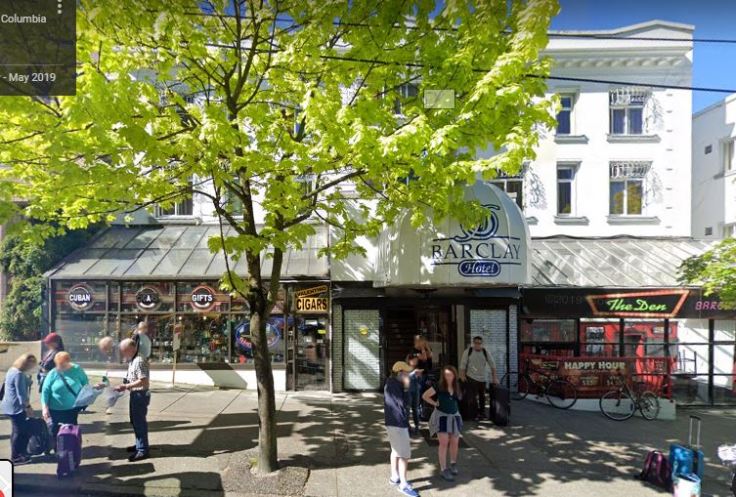
[I have googled the address to see if the building she stayed in was still up – and it appears to be – although significantly altered on the main floor]
Henley Reading, Chess and Music Society – A “penny reading” took place at St Mary’s Hall, New Street on Wednesday evening, November 9, when the following programme was most ably sustained: “the Northern Farmer” (Tennyson), Mr Lister; “The Dream of Eugene Aram” (Hood) Mr Rawlins; song “The Anchor’s Weight” (Braham) Mr W Crouch; “Smugglers and Poachers” (Grabbe) Mr John Cooper; song, “Kitty Tyrrell” (CW Glover) Mr F Paulin; “Odes on the deaths of the Prince Consort and the Duke of Wellington” (Tennyson) Mr Lister; “the Blind Highland Boy” (Wordsworth) Mr Rawlins. The songs were accompanied by Mr A Towsey. The chair was taken by C Lane, Esq and the hall was filled by a very attentive audience.
While doing research for an article on the Paulin(e) family. I began searching for examples of paintings done by Frederick Paulin(e) Sr. The main reason was that I had unearthed a newspaper article dated 1901, which spoke of an exhibit he had at the Great Northern Railway Offices [See below].
I knew that Frederick had been an artist having seen a couple of examples in my travels, but I hadn’t understood the importance that it had for him, which from the fact that he exhibited his work (though humbly) suggests.
So I have decided to launch a search for more examples of his work, to digitally construct an exhibit of his paintings in order to share with his family/descendants and other interested people in his vision of the world, through his art.
Example 1
Beacon Hill Park, Victoria, from the collection of S Bunting.
Example 2
Possibly English River, dated 1909, from the collection of D Thornton.
If you have any paintings by Frederick and would be willing to share with the blog (and the family) I would be most grateful.
Frederick’s son Ernest Alfred Paulin was also a talented artist. I have two examples of his decorative painting.
Example 1
Tin Plate, repurposed Ainsley Ware and decorated with birds. Was a gift to Sidney and Kate [Smith, his in-laws] and dated Christmas 1899, from the collection of G Leitch.
Example 2
Decorated mirror, nd, from the collection of S Bunting. Thought to be a cake plate.
Any images of Ernest or Frederick’s art would be gratefully added to this virtual exhibit. If any other members of the family were visual artists, information and images would also be appreciated.
Work in Progress!
The Gallery can be seen here: https://gilliandr.wordpress.com/pauline-family-art-gallery/
At the landing of the steamer Rithet last night the Messrs F and EA Pauline were on the dock to welcome the arrival of their father and mother, brother
Paulin family in Birmingham, c 1890s – collection of K Paulin
and six sisters from Manchester, England. [Actually – Birmingham] The Messrs Pauline have been in Victoria for several years, and occupy honourable positions in a couple of mercantile houses. Having made a home for themselves, they sent for and are now joined by the remainder of their family, and last night a joyous meeting took place on board the Rithet.




 The Amazing Paulin(e) Family