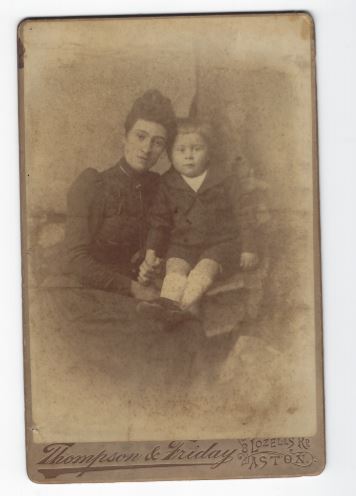
This is an image of Louise Mary Paulin Rutherford and her son, George Frederick Andrew Rutherford, aged 2 years 7 months, which means it was taken in 1891 in Birmingham.
Descendants of Frederick and Mary Paulin gather here

This is an image of Louise Mary Paulin Rutherford and her son, George Frederick Andrew Rutherford, aged 2 years 7 months, which means it was taken in 1891 in Birmingham.

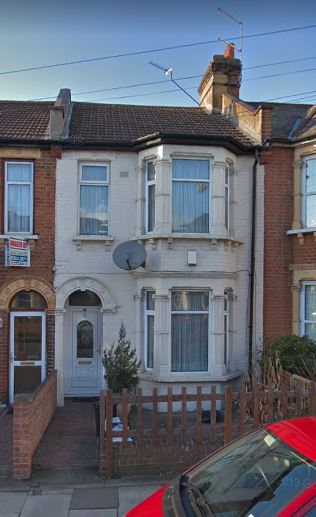
And the moves for the family continued – I have a letter addressed 22 Britannia Road, Ilford. I knew that they lived here from at least 1906, because I had read the files for my great-aunt Hilda [Hilda Louise Paulin Curtis], who attended Cleveland Road School nearby. I did research at the Ilford public library in 2008 and the school records that they had. Grandad [Norman Frederick Paulin] also attended that school.
The house is really like all their other houses – I swear they are all cookie-cutter!!!
Letter from Ernest Paulin to Frederick Pauline, 6 Dec 1908
22 Britannia Road, Ilford
6/12/1908
I thought that I would send you just a word or two with the “Ole” fashion Xmas card.
Because sometimes the writing means more than the card. Nevertheless, when you have nine years “trying to sell typewriters and a pen in your hand about once a month.” Criticism is barred. I nearly danced a “Reel” when I read the official announcement and I am indeed thankfull that you are still better off.
I hope that Bert will prove trumps, George must + will. Of course, I got news sometimes from the Dad + Mother and there
[2]
Is generally something of interest.
It seems hard sometimes that I quite alone here; but I feel sure I could do better out of this Foggy City – It is hard work. But I am not grumbling Fred, am not actually starving + with Gods blessing and the health that is necessary (which I have made a serious study of, since starting a new life back in the old country) I hope to see some of my family once more.
Nothing pleases me better than to hear that your years of hard plodding, thoughtfull life, are an almost assured success. I wish with all my heart that I could shake hands with you, otherwise, than on paper.
[3]
Business generally is very bad. The present government seem to indulge in fractional party politics, or “Locking up suffragettes”
I don’t know whether you ever see the ½ Mirror I send to Dad every day. Would you like it?
Just one more look at your handwriting. It will only cost gone 2c. Please.
Every Xmas I miss awfully away from our Family circle
Ernest
[4]
You will be pleased to know that Harold (who is 21 next March) is doing very well in his 3 years engagement in Weir Scott + Co, Valparaison. He started at £150 a year, with an increase of £10 during the 3 years and good prospects of a continuance of advantage after.
It is a pleasure to send his thanks for getting with the firm, and a further pleasure to know that his employers here feel the same as myself.
Rene + Grace are working now, in a large general supplies stores in Ilford here, and are very proud that they can pay for their own clothes. Hilda + Norman are at School. Norman is learning draughts fine.
Letter Ernest Paulin to Frederick Pauline, 18 Oct 1899
[Typewritten]
“Hillside” Farquhar Road, Moseley
Oct’r 18th 1899
My Dear Fred
I will not attempt to express how thankfull I was to receive your kind enclosure, coming as it did unexpected and just at a time when any pecuniary assistance was more than usually valuable. I should like to have some good news from you and am looking forward to your promised next.
I wrote to George a week or two ago, which letter you might have seen, lettering you know that I have taken a Commission job on the introduction of a new typewriter, the “Oliver” on one which I am writing this short note; as there are thirteen typewriter agencies in Birm’m most of them with a ten years start or more you can imagine that there is not much in it but hard and disappointing work; when I tell you that it has taken me nine weeks to draw £4 you can fairly calculate the up the hill job it is. Nevertheless I have every confidence in the machine and eventually may be better; of course during the disastrous cycle boom here every body was in the cycle trade & every one had typewriters, so now that scores of the mushroom companies are gone, the market is glutted with typewriters of various degrees of perfection and price and these naturally very much handicap the sale anything new, and will do so for some time to come; but “Nil Desperendum”
You may tell the Dad that Red Cliffe House matter is concluded and that by to-morrow at latest I shall forward to him all the particulars of the transaction and hope he will found my stewardship of his interest satisfactory. As my letter to the Dad will be somewhat lengthy
-over-
[2]
I can embody any further items of interest in it, which no doubt the Dad will permit you to peruse. If you could have witnessed the relief that your kindness brought into our almost proverbially empty house, I feel sure that it would have amply repaid you for your kind thoughtfulness. I hope you and yours are well and that Piercy’s trip to Dawson will prove lucrative. Permit me to again express the hope that you kept on the near side of the Klondyke business and that your usual care and tactical discretion will leave your transactions well on the right side.
Emmie wishes me to convey her sincerest thanks to you and the little kiddies, who of course benefitted by your kindness have reminded me several times not to forget Uncle Fred’s present and tell him that now we have got new boots, we are going to school again and they will black their boots every morning and see how long they can make them last.
With kindest love and a hope that I shall get some news from Victoria again shortly,
Your affectionate Brother
Ernest

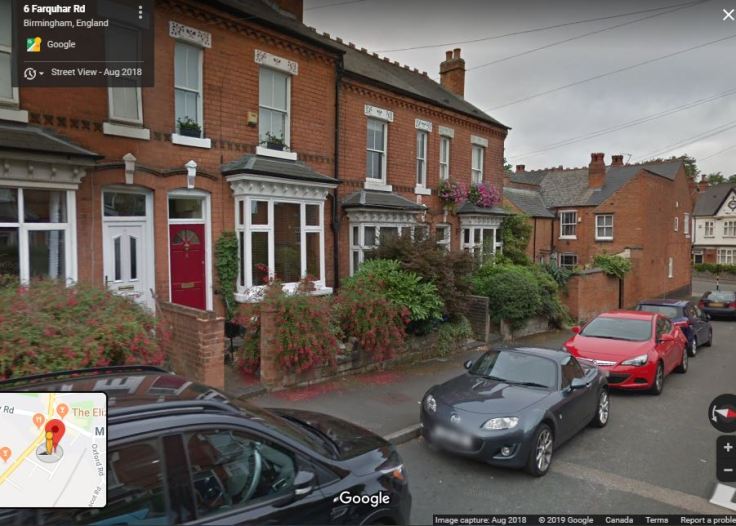
And so the google searches for family addresses continues. Today I present Farquhar Road in Moseley, Birmingham, where Ernest and Emma Paulin lived in October of 1899. I don’t have the house number, just the name “Hillside” which doesn’t work in google maps. So here is a street view of the road, which again features the same kind of late Victorian row housing, narrow, and two stories.
Letter from Ernest Paulin to Frederick Pauline, 9 Mar 1899
[In note form at top of first page]
Emmie sends her sincere thanks and love
257 Frederick Road
March 9th, 1899
My dear Fred
I hasten to say that I have received the two money orders of $10 each and that they came as an undisguised God-send, just at a time when we were feeling the bitterest inconvenience of poverty. You will be surprised to have not yet succeeded
[2]
Obtaining employment, openings are so very rare and so many to fill them when occurring. I cannot adequately express my gratefulness to you and Herbert for the assistance just to hand, I shall write to the latter on Sunday also to yourself more fully.
I am busy today and the rest of the week making copies of all the documents in connection
[3]
With my case against Kynoch’s + which is to be heard any day next week so that the present time is an anxious one for me.
I have a very good case against them, but juries are funny things sometimes and nothing is certain up to the finish. I am sorry you have so many calls upon your purse, but I can assure you that any
[4]
Help you can give me, is accepted as an obligation the very first I shall make a point of satisfying.
Please tell Bert I shall write to him and thank him for his kindness.
I do hope soon to be able to breathe freely once more, but in the meantime rest assured I feel very sincerely your great kindness. Will write again on Sunday
Your affectionate Brother
Ernest


I knew that Frederick had been an artist having seen a couple of examples in my travels, but I hadn’t understood the importance that it had for him, which from the fact that he exhibited his work (though humbly) suggests.
So I have decided to launch a search for more examples of his work, to digitally construct an exhibit of his paintings in order to share with his family/descendants and other interested people in his vision of the world, through his art.
Example 1

Beacon Hill Park, Victoria, from the collection of S Bunting.
Example 2

Possibly English River, dated 1909, from the collection of D Thornton.
If you have any paintings by Frederick and would be willing to share with the blog (and the family) I would be most grateful.
Frederick’s son Ernest Alfred Paulin was also a talented artist. I have two examples of his decorative painting.
Example 1

Tin Plate, repurposed Ainsley Ware and decorated with birds. Was a gift to Sidney and Kate [Smith, his in-laws] and dated Christmas 1899, from the collection of G Leitch.
Example 2

Decorated mirror, nd, from the collection of S Bunting. Thought to be a cake plate.
Any images of Ernest or Frederick’s art would be gratefully added to this virtual exhibit. If any other members of the family were visual artists, information and images would also be appreciated.
Work in Progress!
The Gallery can be seen here: https://gilliandr.wordpress.com/pauline-family-art-gallery/


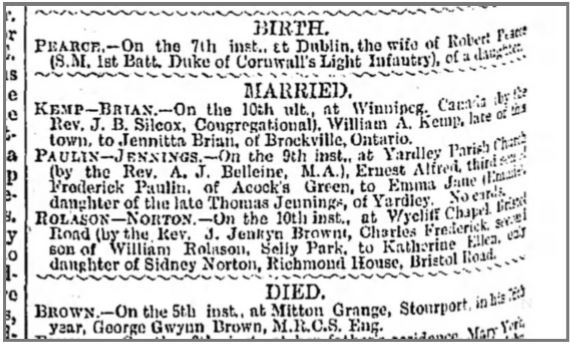
Victoria Colonist, 11 September 1888, page 3
A Joyous Meeting
At the landing of the steamer Rithet last night the Messrs F and EA Pauline were on the dock to welcome the arrival of their father and mother, brother

and six sisters from Manchester, England. [Actually – Birmingham] The Messrs Pauline have been in Victoria for several years, and occupy honourable positions in a couple of mercantile houses. Having made a home for themselves, they sent for and are now joined by the remainder of their family, and last night a joyous meeting took place on board the Rithet.

Victoria Daily Colonist, 24 April 1888, page 4
St George’s day
Englishmen celebrate the Good Saint’s Day in true British Style – at the Banquet Board
Every seat at the round table of the Clarence was filled last night at the annual dinner of the St George’s Society. A larger gathering had never assembled in the large dining –room of that well known hostelry. The tables literally groaned beneath the weight of the good things provided by the mine host Richards and a typical British banquet was the result of the chef’s exertions. To the affable steward, Mr WH Shaw, much of the success which attended the dinner must be attributed. Calla lilies in full bloom, as well as many potted plants, graced the table, but beyond this no attempt was made at decoration. Ex-Mayor Fell presided, having on his right and left Mayor Grant and United States Consul Stevens, respectively. Mr W McNiff, president of the Pioneer’s Society, occupied a seat immediately to the right of the Mayor. Mr CE Redfern did justice to the vice-chair. Rare music (piano and violin) was discoursed throughout the evening. Ven. Archdeacon Seriven asked a blessing. The following was
The Menu
Soup
Vegetable
Hooes d’oeuvres
Crab-salads, olives, celery
Fish
Boiled Salmon, Anchovy Sauce
Roman Punch
Roasts
Beef with Yorkshire Pudding, Sucking Pig
Spring Lamb, Saddle of Mutton
Vegetables
Asparagus, Peas, Tomatoes, Cauliflower, Potatoes
Desert
Plum Pudding, Blanc Mange, Vanilla Ice Cream, Lady Fingers, Macaroons, Fruit
Regrets
The President read regrets from the Lieut-Governor, Lt-Col Holmes, Hon Theo Davie, and the Senior Naval Officer.
Toast List
“the Queen and Royal Family,” by the President. Music: “National Anthem” followed by three loyal cheers and “a tiger.”
The President of the United States” by Vice-President Redfern, Music “Star Spangled Banner”
Lieut-Col Stevens was greeted with cheers. He only wished President Cleveland was here tonight. He would have liked to have seen him witness the hearty manner in which the toast of his health had been honoured. He would have liked that he could see Victoria’s many natural qualities, the beauties of Beacon Hill, of Shawnigan Lake, of the Gorge, of Swan Lake and the countless glories lying around on all sides. He hoped he would yet live to see them. He was glad to know that harmony still continued, notwithstanding the fisheries entanglement, between the two sister nations, and was delighted to say “all goes well.” (Cheers)
“His Excellency the Governor General” by Mayor Grant. Lord Landsdowne was eulogized and his political career narrated. His great success as Governor-General of Canada was told and regret at his early departure was expressed. Music “Rule Britannia”
“His Honour the Lieutenant-Governor,” by Mr Edwin Johnson, who made a very neat address. Governor Nelson, he said, is one of the most popular governors we ever had. He extolled his fine personal and social qualities, and judging by the enthusiasm which followed his brief remarks, Governor Nelson is personally respected and esteemed by each member of the representative gathering which assembled last night to do honour to Britain’s patron saint. Music “ The Minstrel Boy” and “For he’s a Jolly Good Fellow”
“Army, Navy and Volunteers,” by Mr JJ Austin, who spoke of the value of the three services, making especial reference to the noble conduct of the volunteers during the Northwest campaign. Music “Red, White and Blue.”
Hon JH Turner was loudly called for and felt that the duty of responding to this toast devolved upon some gentleman more intimately acquainted with the service than himself. He could call to mind the heroic deeds of the volunteers, encamped on Beacon Hill, on many a cold night, in defence of the government buildings – he had done his duty, if it was a peaceful one. Some people said he was a traitor, but he thought few believed it, he believed in the glorious old flag of St George, was true to it, and if necessary would die for it. (Loud Applause).
Three hearty cheers were given for the Hon Mr Turner.
Mr Fred Miller also responded on behalf of the navy and volunteers, as well as Gunner Foster of “C”Battery, who in the absence of his officers, made a capital speech in which he expressed his thanks for the many kindnesses at the Battery had received at the hands of the citizens of Victoria.
Song, “My Ancestors were English”by Mr E Allen, MPP.
“Mayor and Council” by Mr N Shakespeare, who briefly spoke of the council as a body in felicitous terms and administered a very liberal dose of “taffy” to the Mayor, winding up with a eulogy on the councillors generally. Music: “We’ll may keel row.”
Mayor Grant thought discussion was desirable, and it was only by arguing out the different questions that came before the council to a conclusion that the happy medium could be attained. He thought the motto should be: “Let us help ourselves.” The citizens should assist the council in making the place desirable, in introducing capital, and in advancing the interests of Victoria.
Ald Braden was never so happy in his remarks. Every councillor, he thought, tried to do his best for his ward, as was natural, and if there was a little fighting occasionally, outside all were good friends.
Ald Powell made a practical speech. The aldermen had endeavoured to do their duty, and while there were grumblers in the city, the mass of the people sympathized with them in their efforts to guard the public interest.
Song: “The Muskateers,” Mr G Fairbrother.
“the Day and all who honor it” by ex-President MWT Drake. A brief history of the life of St George was given and the speaker dilated in warm language on the glories of the British. Civis Romanus Sum was the boast of the Roman; “I am an Englishman” is a nobler one (Cheers). Music: “The Englishman”.
Song: “For he is a jolly good fellow”
Col Stevens on “a question of privilege” made a vigorous address, eulogistic of the flag of St George, which was followed by loud applause.
President Fell made a splendid after dinner speech.
Song: “the Englishman” Mr Fred Miller.
“The Clergy” by Ald Powell, who made the hit of the evening in his reference to Britain’s glory – the Bible, and her Christianizing influence, through the clergy, the world over.
Responded to by the Ven. Archdeacon Scriven who said he had lived long enough in this city to thank God that his lines were cast in such pleasant places. It was a lovely city, and he hoped to make his home here. On behalf of his brother clergymen he thanked all present for the hearty manner in which the toast had been received.
“Sister Societies” by Mr G Fairbrother. Music: “Auld Lang Syne.”
President AJ Smith of the St Andrew’s and Caledonian Society, responded in a stirring speech and did ample justice to his “brithers the world over”.
Mr T Russell was obliged to rise to his feet and say a few kindly words of thanks to the heartiness with which the toast was drunk.
Mr W McNiff, president of the Pioneer Society, made one of his characteristic speeches, witty, eloquent, and to the point. He closed by thanking the gathering for honouring in so marked a manner “the leading society of the province” (cheers) “Muldoon, the Solid Man” was loudly called for and quiet could not be restored until Mr McNiff delivered it in his own unique manner.
Ex-Mayor Fell spoke on behalf of the BC Benevolent Society.
Song: Mr G Fairbrother, “There’s room enough for all”
“The Press” proposed by Ald Braden. Music: “Bid Me Discourse” song by WH Ladner, MPP. Responded to by Mr O’Brien of the Colonist, Mr Templeton of the Times, and Mr Beveridge of the Standard.
The President paid a fitting tribute to the memory of Hon Thomas White, one of Canada’s pioneer journalists.
Song: “The Ivy Green” H Mansell
“The Ladies” by Mr F Pauline, Music: “Here’s a health to all good lassies” Responded to by Mr J Orr, MPP, who described in song how St Patrick’s Day came to be on the 17th of March amid uproarious laughter.
This being Mr Orr’s birthday, Vice-President Redfern proposed his health, which was drunk with “no heel-taps” and cleverly responded to.
Songs: “Then You’ll Remember Me” Mr Redfern, “The Scarlet Flower” Mr T Flowin; “The death of Nelson” Ald Braden; “Harry Bluff” Mr James Fisher; “The Union Jack of Old England” Mr Henry Farrell; “In Happy Moments” Mr Martin; “Good bye Sweetheart, Good bye” Mr E Allen MPP; “The Red White and Blue” Mr S Harrison; “the Pilot” Chas Jenkinson; Piano solo, Mr Levin; “The Midshipmite” Mr F Pauline; “Blue eyed Nellie” Mr Farrell; “Old Black Joe” quartette; “Merrie England” Mr McNish; “God Save the Queen” and three cheers and a “tiger” for Her Most Gracious Majesty brought the pleasant evening to a close.
 The Amazing Paulin(e) Family